Showing posts with label the book. Show all posts

Tuesday, November 27, 2018

Yay! Royalties!

I was at the local Barnes & Noble the other day picking up a birthday present for my sister and, while there, decided mosey over to the science section to see if they had any copies of my book. What to my wondering should appear, but a paperback edition of Discovering the Mammoth. It looks very nice. I bought a copy to show people and took it to dinner at my corner brewpub. While I was showing it to some of the regulars, two young women from Seattle asked about it. I ended up selling it to them and autographing it with a cartoon of a mammoth in the snow.


The hardback was paid for by an upfront advance that was gone by this time last year.* For this edition, I'll be paid with royalties that will come twice a year. I don't expect more than a few hundred dollars per check, but it will be a nice little bonus when each arrives.

* That's why I was begging all year, hunting for work, and too depressed to write. Last month, I started receiving Social Security which, while not enough to make me completely independent again, has taken a lot of weight off my shoulders. I've already begun writing again and will have some things for the blogs very soon.

Thursday, August 31, 2017

This Is Going to Be So Fun

This week the book was reviewed in The Wall Street Journal. The reviewer (Richard Conniff) takes a while to get to the book, preferring to start with wondering who I am.
 Discovering the Mammoth is one of those books that make you wonder about the author as much as about his topic. John J. McKay writes that he got started with a single blog post aiming to establish "a chronology of what was known about mammoths and when." Or rather, he got started because he noticed, while indulging his "great love of conspiracy theories and fringe ideas," that "lost history theories"—think Atlantis, flood geology and rogue planets—" all used frozen mammoths as proof positive of their ideas."
 I've written about this before.

One of the most popular contemporary catastrophist writers, Graham Hancock, has just issued a call to his readers to help him on a new project. He wants to know if anyone knows anything about mammoth discoveries, specifically if they know anything about Alaska. Hmmm.

Do I know anything about mammoth discoveries? Yes.
Am I familiar with catastrophist literature? Yes.
Am I familiar with recent geological literature on the soils in which late Pleistocene bones are found? Yes.
And other relevant scientific literature? Yes.
Do I know anything about Alaska? Yes.


So, here's a question, should I invite Mr. Hancock to Alaska so I can give him a tour of the places where mammoths are found and introduce him to the experts? It would have to be on his dime, of course, and I would reserve the rights to document the trip.

In any case, I plan to write about t his a lot.

Saturday, August 12, 2017

My book is out

As of Tuesday, my book is officially out. Rush to your local bookseller and demand they sell you a copy. Get your friends and family to buy one. Badger your local library to acquire multiple copies. Donate one to your high school. Nag the school board to design a course based on it. I'm available for interviews. I'm available for signings. I'm available for lunch (if you're paying). Let's sell this thing.

This is a huge milestone in my life. Actually, several milestones in several aspects of my life, but let me stick to the most obvious. This is a major punctuation point in that project. I came up with the idea, sold it to an agent, who sold it to a publisher, who helped me edit the final copy, which was printed, and officially came out Tuesday. Preordered copies were shipped and my friends have been reporting receiving them all week. Technically, the project isn't over. I need to help sell it; do interviews, readings, and signings; and possibly write some more related mammoth materials.

This milestone is also a call to start a new project. I've written before how the book grew out of the idea for a single blog post, that became a series of blog posts, to a short book, to a dissertation. The two things I want to write now are the book I've wanted to write for thirty-five years--my history of the aftermath of WWI--and the other is another blog post gone out of control--my interpretation of the psychology and history of American political partisanship. Both have contemporary relevance.

The WWI book is coming up against marketable centennials. This will be an easier book to write. I've not only been thinking about it for over half of my life, it's the field of history that I specialized in during grad school. I own over a hundred books relevant to the topic. Unfortunately, the books are all in storage in Washington while I'm stuck in Alaska.

The book on recent partisanship in American politics, is something I've started over and over again as a blog post. I always get stuck at the point where I want to start citing sources. This is where my mammoth book got out of control. Tracking down things I've read over the last twenty years, just for a long-read blog-post that fewer than fifty people will finish was too discouraging to contemplate. It would make a great magazine piece, but I doubt my mammoth book alone is enough credentials sell the idea.

I'm also tempted to drag out some of my other abandoned, long blog-posts and try out publishing an e-book just for the experience. Unfortunately, many of those posts are on a hard-drive, stored with my books over a thousand miles away.

Decisions. Decisions.

PS -- Buy my book.

Saturday, July 15, 2017

And yet another

Oh look, here's another review. Barnes & Nobel has this one on their page for the book.
Library Journal
When people first encountered the extinct mammoth remains, opinions varied on what these creatures were. In a thorough look at the beginning of paleontology, especially cultural influence and assumptions, technical writer McKay traces how people interpreted this mystery. The author organized centuries of sometimes messy findings into a coherent report spanning continents. History enthusiasts will appreciate learning how the mammoth and other discoveries were documented or lost. Shipwrecks, fire, and improper preservation destroyed evidence; inaccuracies in maps, sketches, and written descriptions impeded comprehension. Readers will find it humbling that the greatest minds of past centuries were adamantly wrong and will enjoy reading about their rationales: of course, it made sense to believe that mammoths lived underground and couldn't survive upon reaching the earth's surface. Similarly, those who held to a literal interpretation of the Bible assumed that the mammoth skulls belonged to giants who once roamed the land (the concept of a defunct species would have implied a flaw in God's design, a heretical thought).
VERDICT For those seeking a scholarly, straightforward examination of paleontology's origins and key players. 
—Elissa Cooper, Helen Plum Memorial Lib., Lombard, IL
Damn, this is fun.

Wednesday, July 12, 2017

Another review

Today, I have a review on Booklist Online. It will also go out in their weekly news letter. It's recommended both for adults and teens. Since it's behind a subscription wall, I'll quote the whole thing here:
Discovering the Mammoth: A Tale of Giants, Unicorns, Ivory, and the Birth of a New Science. McKay, John J. (Author) Aug 2017. 256 p. Pegasus, hardcover, $27.95. (9781681774244). 569.6.
Humans and mammoths coexisted until 10,000 years ago, but in the intervening years, humans lost that knowledge, even though they continued to find mammoth bones and trade in their ivory. In the seventeenth century, the recovery of teeth and bones of giant land mammals validated, for some, the existence of the mythical creatures described in the Christian Bible and local folklore until a modern elephant skeleton was first seen in Europe, and observational connections were made. But how could elephants, hot-weather animals, have gotten to North America and Europe? The great deluge described in the Bible was one explanation. Giant bones from a similar time frame were found in North America. Russian expeditions to map routes to Asia led explorers through some of the most fertile areas for mammoth ivory and bones. A nearly complete mammoth found in Siberian glacial ice helped to fill gaps in scientific knowledge and place this extinct species in the animal kingdom. McKay masterfully weaves an intricate story of the events, politics, people, and scientific development associated with the “rediscovery” of mammoths. — Dan Kaplan
Heh. "Masterfully."

Tuesday, July 11, 2017

Book update

The book has been printed. The printer started shipping to wholesalers last week. It should finally work it's way into your local bookstore the first week in August.

Meanwhile, the British science journal, Nature, is planning to review it and the Christian Science Monitor will be interviewing me for their review page.

Thursday, June 29, 2017

To my journalist and media savvy friends

This is an expanded version of something I just put on Facebook. Most of my Facebook friends know I currently live in Anchorage, Alaska. I hope here to get some advice from a wider audience.


Here's a gratuitous mammoth picture so you'll stop and read the post.

My mammoth book comes out in six weeks. I need to do what I can to help promote it. My publisher is sending out review copies to some science magazines. I'm thinking more local. Who should I point them to at Alaska Dispatch News for a review? Would any of the columnists be interested in a local author piece (this goes for the whole northwest. I lived in Seattle for twenty-five years)? What about readings and signings now that Titlewave (the main independent bookstore in Anchorage) is no longer selling new books? Podcasts (can be anywhere, not just Anchorage)? Any ideas for local opportunities or further afoot? Events at museums or guest lectures for paleontology classes?

I'm trying to find some way to move back to the Seattle area. If I do get back, I'd love to arrange events at Elliott Bay Books (where I used to work), the University Bookstore, Powells in Portland, and all points between. Maybe Seattle Times or other regional papers would be interested? Again, does anyone know who would be the best person to query? Bigger papers get lots of unsolicited books to review; as with everything, a contact is infinitely better than a cold call.

PS - As a writer, I am available to write "what this latest discovery means" pieces. I'm also open to mentoring on how to sell such stories. If you're a writer with experience at this, teaching me would be good exposure (#PleaseDontHurtMe).

Monday, June 12, 2017

We Have a Review!

Publisher's Weekly, the trade journal of the publishing industry, chose the Discovering the Mammoth to be reviewed this week. They can only review a fraction of the new books each week, so I think this is a good sign.

Monday, May 15, 2017

It's me

I don't usually post pictures of myself online. None of my social media avatars are pictures. But, the publisher needed a dust jacket photo, so I may as well share it. After all, it's going to be printed by the millions when my book becomes an international, runaway bestseller.

Tuesday, February 21, 2017

Book Update

Last night, at around midnight, I finished the last revisions on my book and shipped it off to publisher. My editor will be taking it to the London Book Fair next month. She also told me Nature has requested a review copy.

Monday, November 21, 2016

Book Update

My publisher, Pegasus Books, has released their summer catalog for next year and guess who is in it? This means it's starting to show up on the pages of Amazon and other fine booksellers. When I pointed this out on Saturday, some of my friends went pre-ordered copies. This gives it a sales ranking in the Amazon system and, as of today, it is the #1 New Release in Science > Fossils.

Amazon
Barnes & Noble
Powell's (Portland)
Elliott Bay Book Company (Seattle)

I worked at Elliott Bay for three years. I hope I get to do a reading there. If you have a favorite independent bookstore that you'd like to give a shout out to, mention them in the comments.

Friday, September 23, 2016

And we have cover art


Wednesday, September 21, 2016

Book Update

My publisher just showed me a mockup if the book cover. There are some changes that we want to try out. When everyone is agreed on a version, I'll get to show you all. There've been some delays at the publisher (they moved their editorial offices) and my release has been bumped back to June. This gives up plenty of time to work on a pitch to out friends as to why woolly mammoths are the perfect summer read. More to come...

Monday, June 6, 2016

Now What Am I Supposed to Do?

Have I mentioned lately that I was writing a book? Yep, little, old me. Saturday, I finished it. It's written, proofed, noted, biblographied, illustrated, and captioned. Then I tied it up with a virtual bow and shipped it off to my agent. It weighs in at a petite 88,592 words. This morning I heard back from her. She thinks it's satisfactory, or, as she put it, "You are amazing! Not many first time authors (or seasoned ones!) can deliver so complete—and to my quick perusal—excellent, an enchilada on such a tight timeline." I am rather proud of my enchiladas.

Saturday, March 12, 2016

The Missing Swedish Source

The other day, I went to check out how I referred to something in chapter four to make sure I was consistent in chapter five. To my horror (really, horror), I discovered that the version I had saved was not the last version I wrote; it was the one before. All of the editorial corrections and content additions I had made were gone. After the predictable two hours spent checking everywhere for the corrected version, hoping the additions were in another file, and repeatedly looking in the trash can, I arrived (Denial, Anger, Bargaining, Depression) at an acceptance of my screw up.

Sigh, do it over. My many-times published, childhood friend, David Neiwert, pointed out that, while this is horrifying, having had a chance to get your thoughts together once and mull it over, the second version is usually better. He's right. At least that's how it works in non-fiction. I'm sure many poets would punch us in the face for saying that. But, then, poets are an emotional lot.

And so, after remaking the editorial corrections, I spent today recreating the missing addition. Naturally, I went back and re-researched it. My new version is four times as long as the last version. Telling it in greater detail might add clarity to the narrative, but there is  a problem. This anecdote is the weakest sourced section in the entire book. It's based on what I call "the missing Swedish document."

One of the reasons this book has taken nine years to write has been that I have sourced everything. I don't want to claim to be able to read the minds of long dead people. When I was a kid, the young people's histories we were given (often written in the 19th century) were full of "when Bobby looked at the open sea, his mind was filled with thoughts of the adventures he would have." For all we know, Bobby was filled with terror at the thought that he would be raped half way around the world before dying of scurvy. And leaving such a childish genre, my own graduate studies were filled with statements of what Stalin wanted or was planning. Was Stalin planning to invade Western Europe when he died in 1953? I think he wanted to. I'm not sure he was brave enough to actually have planned to do it. In my studies, the only solid evidence I've seen is that he planned to invade Yugoslavia later that year.

Back to the mammoth. I have what I think is a significant anecdote. I've hesitated to add it because I can't source it. All I have is "a certain Swede said... ." I'm sure I know who the certain Swede is, but I can't find where he said it nor can I find a direct quote anywhere else. All I have is this oblique reference. I'm sure the first reviewer of the book will latch onto this point and ask about it.

I'm doomed.

Friday, January 15, 2016

Book Update

We sold the book.

I've been holding my breath over this, but it finally came together today. Last spring I started sending lots of query letters to agents. In June, one asked to see my full proposal. A few days later, she asked to talk to me. At the end of the talk, she offered to represent me. I accepted and she sent me a contract. After that, we worked on improving my proposal and working up a better sample chapter. Just before Thanksgiving she said she thought it was ready and that she was sending it out to publishers. The week before Christmas, two publishers wrote back asking for more information. One was a small university press. The other was a major publishing house. Ten days ago, the University press made an offer. It was a much smaller offer than I had hoped for, but it was exciting to think that, no matter what happens, the book will see the light of day.

Fast forward to today. We still haven't heard back from the big publishing house. It's Friday. There was only junk mail in my box. Considering the time difference, it was already after lunch in New York. I figured that meant I wasn't going to hear anything this week. I deleted all the junk mail and as Gmail refreshed, a new letter appeared from my agent. A third press was interested and was making an offer. The new offer was more money, greater marketing mojo, and a hardback release sooner than the university offer. Other than the million-dollars-and-a-cheese-sandwich offer that I never really expected to get, this was everything I had realistically hoped for. I wrote back basically saying "OMGOMGOMGOMGOMGOMGOMG, YES!!!"

The normal procedure, at this point is to notify anyone else who has expressed an interest to see if they want to start a bidding war. An hour later, my agent wrote back to say, this morning's publisher raised their bid and the other two dropped out. Most people who have met me will say that, with exceptions that don't need to be listed here, I'm usually a fairly reserved person. I was screaming and dancing in the kitchen. "Tell them yes! Tell them yes! Tell them yes!!!!"

And that, dear friends, is where we stand. The publisher will send a formal contract to my agent stating the terms of the bid; she'll examine it and, if everything is above board, send it to me to sign; I'll fall to the floor in a swoon, then get up; and sign it. Naturally, about five minutes after I gave her my permission to accept the bid, my impostor syndrome kicked into overdrive. Unless some drunken prankster in mail-room of the publisher sent the bid, I now have four months to deliver a draft.

It's finally real. Ever since I was a teen-ager, I've wanted to be a writer. My topic has changed over the years: first I want to be a science fiction novelist, then I wanted to make important contributions to my fields of graduate study (modern Balkans and colonial Africa). After dropping out of grad school, I became a technical writer. It was pretty cool to fill out the "Occupation" box on my tax forms with "Writer" even if the writing wasn't that exciting. Blogging was a little more satisfying, but eventually that became harder to do as traffic dried up. Somewhere along the way I stumbled into mammoths. It was nothing more than a blog post that I meant to use to illustrate a different point. Nine years later, it's a book. I think on my next tax form I might write "Author."

Thursday, August 27, 2015

Some notes on translating

So far I've translated about 2000 pages out of ten languages that I don't speak. Here are my top three problems:

1. Though most of what I translate is technically in the modern form of these languages, the spelling isn't. If I actually spoke the languages, I could pronounce the words out loud and them figure out.

2. Some writers are overly flowery or just plain bad stylists. This often defeats the available grammar of my translation programs leaving me to bludgeon my way through in short phrases or even word-by-word.

3. Actual typos in the source material. I figure out the grammar part and start entering every possible variation I can into various dictionaries and none of them is a word. Finally, I realize they weren't minding their P's and Q's and everything is fine.

Bonus observation: About three years ago I noticed something odd about the way the long and short S was used in some documents. There two sets rules for their use. The difference centers on when to use the short S. In some pieces they would be using one set of rules and suddenly shift to a different set. At first I thought they didn't have enough pieces of long S type to do some sheets and shifted over to the rules that allowed more short S's for those sheets. Just last week I finally figured out what was really going on. I was reading a monthly journal that probably needed to be assembled and printed fairly quickly. The printer was a fairly large house and must have had more than one typesetter working in the shop with some of them using one set of rules and some using the other.

I'm writing this to avoid working on a Latin document that is rife with sin #2. Get back to work, John.

Monday, July 20, 2015

I Just Signed Contract With a Literary Agent

I HAVE AN AGENT!!!!!! OMG,OMG,OMG,OMG,OMG,OMG,OMG,OMG,!!!!!!

Sunday, June 7, 2015

I Need to Get Some Platform

I'm back. Did you miss me? You may or may not have noticed that, since last summer, I've more or less given up blogging. Now I think it's time to start up again.

This weekend, I've been looking into literary agents. I sent queries to a handful that sounded like they would be a good match for me and the book. One word that stood out on many of their sites was "platform." They want writers with a strong platform. Platform, in this context, means voice and visibility. You probably know that publishers these days want authors to take an aggressive role in marketing their books, initiating events that don't require any investment by the publisher. Platform means they want to see authors who are positioned to do this even before the book is published. In non-fiction, this means they want the author to be an recognized expert in their field. Since I made up my field (historical mammothology) I am the world's leading authority in it, but I am falling down on the "recognized" part of that formula.

This brings us back to the blog. I need to get some new material in here, write frequently, spiff up the look a little bit, and find some way to create some "added value." And, most importantly, I need to get some traffic moving through here.

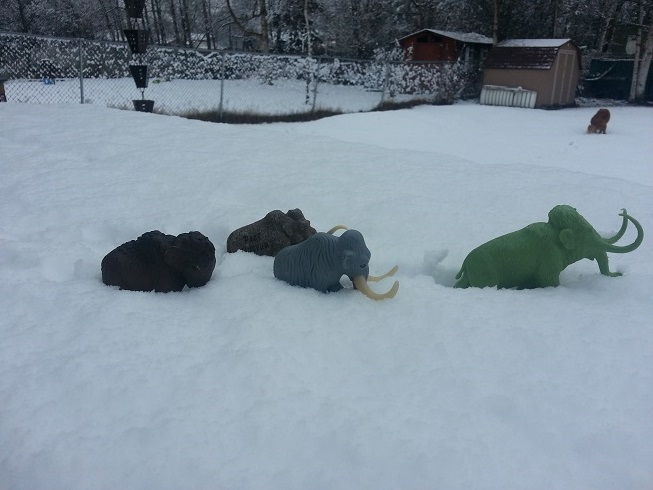
Meanwhile: here's a herd of mammoths trudging through a late spring snowfall.


Thursday, April 10, 2014

Book update

Today I received another rejection, or semi rejection, letter. The editor wrote that it sounds like an interesting project and invited me to submit the completed manuscript when it's ready. I read that to mean she thinks the concept has potential, but is not willing to risk an advance on a writer with no publication history or academic credentials. Crap.

The problem, at this point, is that there just aren't that many well distributed publishers of non-fiction that will consider unsolicited proposals. My next move will be to:

A. start submitting to smaller university and regional presses or
B. look for an agent.

Both of these probably represent a reduction in profit and money is an object for me. I've spent seven years on this and, being broke and unemployed, I would like to make enough to live on while I finish it and maybe even be able to get an apartment.

Tessa had an old Peanuts cartoon that we kept on the fridge door. Snoopy was sitting on his doghouse typing. The caption reads: "Dear sirs, With regards to your rejection letter. What I wanted was for you to send me fifty thousand dollars and publish my book. Didn't you know that?" Apparently they don't.