NOTE: The Open Laboratory 2009: The Best in Science Writing on Blogs was released today. I'm excited that one of my mammoth pieces was chosen for inclusion. The story of the Adams Mammoth is something that will be included in my book, so this essay is a sort of sneak peek at things to come.In the far north, when the sun returns after its complete absence during the debt of winter, it is not yet spring. The temperature remains well below freezing for several months more. But as the days grow longer and the temperature creeps upward, the snow shrinks, first compacting and forming a hard crust, and finally it melts. The thaw, when it arrives, is not the same as the thaw in more temperate latitudes. In the far north, the melt water cannot soak into the ground, because the ground is permanently frozen. Instead, it flows across the surface hunting for a path to the sea. The same frozen ground that prevents the water from soaking in, prevents the rivers from carving deep channels. Instead, they are wide and when the melt water arrives they become wider still. A small river easily becomes a mile wide and a great river, like the Lena, becomes ten, twenty, or even more miles wide. Every year the river explodes onto the land, searching for new channels, tearing at hillsides, carrying away trees and millions of tons of earth. Sometimes the raging waters uncover treasures.
During the short summer that followed the floods, it was the habit of Ossip Shumachov and his brothers to search for ivory along the beaches of the Bykovski Peninsula. Shumachov (various spellings have been given for his name over the years) was a chief of the Batouline clan of the Evenki. Shumachov's people were better off than other Evenki (called Tungoos or Tungus by most Europeans at the time). The land they called home was productive enough that they lived in permanent cabins in a small village. They owned domesticated reindeer and traded with the Russian merchants who worked the Lena and the Arctic coast. In exchange for the knives and other metal tools the Russians brought, Shumachov's people trapped furs and hunted for ivory. However, looking for ivory was not something dependable that Shumachov and his brothers could dedicate a special time to. It was something they did along side their more important hunting, herding, and fishing.
In the summer of the year that the Russians called 1799, after the fish runs in the Lena had ended, Shumachov took his extended family to the Bykovski Penninsula to hunt wild reindeer. After building the teepee-like huts that served as temporary homes for his band, Shumachov went out to examine the coastal bluffs and see what windfalls the spring storms might have exposed. On the seaward side of a hill called Kembisagashaeta, near the top of the bluff, he noticed a dark mass just beginning to be exposed. He climbed and examined it, but couldn't tell what it was. With more important things to do during the short summer, he didn't spend any more time investigating the mass.
 Evenki fishing camp on the Lena Delta, 1881. Shumachov's camp would have looked very much like this. The conical tents are constructed in a manner similar to teepees but with walls of birch bark instead of buffalo hide.
The next summer, when his family returned to the peninsula, Shumachov found a dead walrus on the beach below the mysterious mass. I'm not sure why Adams, the person who recorded Shumachov's story, thought the walrus was important enough to mention. It might be that, in stopping to look at the walrus, Shumachov was reminded of the mysterious mass on the hill and stopped to examine it again. Or the connection might through the subject of ivory. A dead walrus on the beach would be a smelly mess in no time, though a welcome buffet to seagulls, foxes, and polar bears. Shumachov's primary reason for investigating a dead walrus would have been checking to see if the thick skin was salvageable and if it had tusks that he could cut off and sell. Whatever his reason for stopping, Shumachov noted that enough of the mysterious mass had eroded out that he could see that it was made up of one large part and two smaller ones. He would later discover that these were the body and two feet of a mammoth.
By the third summer, enough of the side of the mammoth had been exposed for Shumachov to see one of the tusks. Returning to the camp, he told the others about his discovery. Shumachov expected the news to be cause for celebration; instead, the older members received it with expressions of sadness. The old men explained to him that several generations before, a hunter had discovered a mammoth carcass near the same spot. He and his whole family died soon after. Because of that, the people of the region viewed mammoth carcasses as portents of disaster. Shumachov became sick with worry and retired to his cabin to die. After a few weeks of not dying, he decided the old stories weren't true and returned to the bluff to hide his discovery.
The next year was colder than usual and the mammoth didn't thaw any further. Adams' account doesn't mention it, but it's possible that Shumachov's efforts at hiding his treasure might have insulated it from whatever warmth there was that year.
Finally, at the end of the fifth summer, 1803, the bluff had eroded and thawed enough for the mammoth to break free and tumble down onto the beach. The following March--still the debt of winter, but a time of little activity, waiting for the spring hunting and fishing season--Shumachov and two companions left their village and returned to the Bykovski Peninsula to collect the ivory treasure. The tusks were nine feet long and two hundred pounds each. That summer, Roman Boltunov, a merchant from Yakutsk sailed down the Lena and, when passing through Shumachov's village, bought the tusks. The price was fifty rubles worth of trade goods--roughly $975 today. For a people who lived almost completely outside of the money economy, this would have been a great boon to his village. When he heard that the ivory came from a complete mammoth, Boltunov was curious enough to go to the spot and make a drawing of how the animal must have looked in life. Shumachov had watched the mammoth slowly reveal itself and waited to collect the ivory for five years. Having done that he had no further use for the carcass; he left it to wild predators and fed some of it to his dogs. There is no evidence that Shumachov's people ate, or even tried to eat, any of the mammoth.
In the one hundred ten years since Evert Ysbrants Ides first reported the discovery of a mammoth carcass, only four more had been reported and none of them had been recovered or made available for European scientists to examine. Dozens more were probably discovered during that time, but never reported. Shumachov's mammoth would have shared the fate of all the others except for one of those fortunate coincidences of history that placed the right man in the right place at the right time. That man was Mikhail Adams, a naturalist from St. Petersburg (not from Scotland, as is sometimes reported).
Although only twenty-seven, Adams was already a veteran field biologist. Soon after the kingdom of Georgia was annexed to the Russian Empire, he traveled in the entourage of General Apollo Mussin-Pushkin to inspect the new frontiers and brought back several new species of flowers. In 1805, the Foreign ministry began planning a major diplomatic effort to increase trade with China. A naval mission, commanded by Count Adam Krusenstern, sailed around the world, aiming to open Chinese and Japanese ports to Russian trade. A second mission, under Count Yuri Golovkin, was to travel overland, hoping to open the entire Chinese border to Russian merchants (at the time, only one road was open to Russian merchants and it was subject to frequent closure by the Chinese). Both missions included scientific teams. Because of his success on the Georgian mission, Adams was the natural choice for a mission to the other end of the empire.
From diplomatic and commercial standards, both missions were complete disasters. The Golovkin mission, which had swollen to over three thousand members by the time it reached the Chinese border, camped in Mongolia for over three months arguing over protocol. In February 1806, the Chinese told the Russians to leave. The mission broke up in Siberia. While Golovkin and the diplomats returned to St. Petersburg to explain their failure to the emperor, the scientific team stayed in Siberia and split up, each to pursue their own research. One of Adams' colleagues, the linguist Julius Klaproth (son of the discoverer of uranium), collected information from Tibetan and Buryat Lamas about the origin of the word "mammoth" and what they believed about the beast.
Thanks to Golovin and the Chinese getting snitty with each other, Michael Adams found himself in Yakutsk at the beginning of the Siberian summer in 1807.
I was informed at Jakoutsk, by M. Popoff, who is at the head of the company of merchants of that town, that they had discovered, upon the shores of the Frozen-Sea, near the mouth of the river Lena, an animal of an extraordinary size: the flesh skin, and hair, were in good preservation, and it was supposed that the fossile production, known by the name of Mammoth-horns, must have belonged to some animal of this kind.
M. Popoff had, at the same time, the goodness to communicate the drawing and description of this animal; I thought proper to send both to the President of the Petersburgh Academy. The intelligence of this interesting discovery determined me to hasten my intended journey to the banks of the Lena, as far as the Frozen-Sea, and I was anxious to save these precious remains, which might, perhaps, otherwise be lost. My stay at Jakoutsk, therefore, only lasted a few days. I set out on the 7th of June, 1806...
It was well into August before Adams reached the mammoth carcass and he had to work quickly to gather the remains and get back to Yakutsk before the Siberian winter set in. His first sight of the mammoth was not encouraging. For the two years since Shumachov removed the tusks, the carcass had been at the mercy of local scavengers, most of the flesh and organs were gone along with the trunk, the tail, and one of the fore legs. Adams wrote that he could smell the rotting carcass from over a mile away. But further inspection showed it to be a scientific treasure.
Two of the feet were completely intact, with skin and flesh still covering the bones. One eyes and the brain had dried up, but were still in place and undamaged by predators. The eye was later destroyed when the skin was being dried. Most of the skeleton was there and many of the bones were still held together by ligaments and skin. This would make reassembling the skeleton a much easier task and add confidence that the reconstruction was correct. Even with a leg missing, this by far the most complete skeleton ever recovered.
The missing trunk was a disappointment, but not a problem. European naturalists had known that the mammoth was some kind of elephant since the middle of the previous century. The debate had been about what kind of elephant it was. But while Adams knew how an elephant should look and had no doubt that a trunk had once been there, the Siberians he encountered were a little more puzzled. The merchant Boltunov, who bought the tusks, viewed the carcass after the trunk had been carried off. He made a drawing based on what he thought the animal must have looked in life. This was the drawing that Popoff gave Adams in Yakutsk and that he sent on to St. Petersburg.
Boltunov viewed the mammoth after he bought the tusks from Shumachov. His reconstruction indicates that the scavengers had already carried off the trunk and that most of the fur had fallen off the skin. To him, the big blocky body looked like a giant boar. He placed the hair, in boar fashion, as a line of bristles running along its spine. The handlebar mustache placement of the tusks might be intended also to resemble the outward angle of a boar's tusks or it might be a wild fantasy on Boltunov's part.
While Boltunov was completely wrong about the tusks and snout, he bettered Adams on the tail. Adams, on finding the mammoth with no tail, determined that their had never been a tail. Boltunov, who saw the carcass over a year before Adams saw a short tail and included it in his drawing. Adams either did not look closely at Boltunov's drawing or, since the front half of the reconstruction was so wrong, dismissed the back half. When the skeleton was reassembled in St. Petersburg, the academy sided with Boltunov and added a tail, leaving only the exact length open to debate.
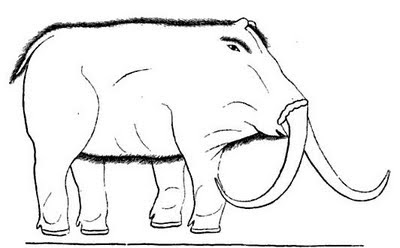 Roman Boltunov's drawing.
After the skeleton, the skin was the best preserved part of the mammoth. Adams reported that the skin was "of a deep grey, and covered with reddish hair and black bristles." The hair was over two feet in length. After separating the skin from the skeleton, Adams loaded both on sledges made of drift wood. The skin was "of such an extraordinary weight, that ten persons ... moved it with great difficulty."
After the skin was removed, Adams carefully gathered all the hair he could find, bagging up over forty pounds. Most of the hair had fallen off the skin before Adams arrived and nearly all of the rest fell off when the skin was dried for transport back to St. Petersburg. This left plenty of room for subsequent debate as to whether or not the mammoth was truly adapted to a cold climate.* Adams described the hair as a mane, which was taken to mean that the hair that remained attached to the skin when he arrived was mostly around the neck and shoulders. Boltunov's drawing, which was made a year before Adams arrived, does not show a mane. Either because it was not well distributed or because of the cartoon nature of the drawing, this difference was only noted by a few naturalists during the next century.
With everything packed up for shipping, Adams took a few days to explore the peninsula and make observations on the local geology and botany. The first step of the 11,000 verst (a verst is roughly equivalent to a kilometer) journey back to St. Petersburg, was to load the remains into a boat that would take them up the Lena River to Yakutsk. The boat hadn't arrived when Adams needed it, so he tied his sledges to reindeer and hauled everything down the coast until he located the boat. In Yakutsk, he acquired a set of tusks that he wrote were the very ones Shumachov had sold to Boltunov two years earlier. He added these to rest of his cargo and sent the whole load to capitol.
Word of Shumachov's discovery had leaked out after Adams notified the Academy that he was going to try to recover the mammoth. Copies of Boltunov's drawing were sent to several leading European naturalists, including Cuvier and Blumenbach. Boltunov's reconstruction of the mammoth as a giant boar, though not believed whetted their curiosity to know more. When the mammoth arrived in St. Petersburg, sections of the skin were cut off, packaged with some of the hair, and sent to important museums and collections in Western Europe. Surprisingly little was done with the skin and hair after its arrival in the capitol. Presumably, the naturalists at the academy eagerly examined it, but no detailed report was published.
Back in St. Petersburg, Adams wrote an account of his expedition. The Russian version of his account was published before the end of the year. French, German, and English translations were published the next year and eagerly poured over by scientists and educated laymen. That they got to see Adams' account so quickly demonstrates the different world that scientists inhabited in those days. In August 1806, while Adams was preparing to leave the Lena delta, the War of the Fourth Coalition broke out with France and its German allies on one side and Russia, Prussia and Britain on the other. While Napoleon defeated Russian armies and created a new Polish state, scientists in Paris and St. Petersburg exchanged papers and discussed science unbothered by things like war and politics. After Boltunov's drawing and Adams' expedition narrative, naturalists in Russia and abroad wanted to know the juicy anatomical details. For these they would have to wait longer.
The job of reassembling the mammoth was entrusted by the Imperial Academy of Sciences to Wilhelm Gottlieb Tilesius. Tilesius, like Adams, had been part of Russia's ambitious, but unsuccessful, diplomatic efforts towards China. As the scientific artist for Krusenstern's naval expedition, Tilesius produced ethnographic drawings of Pacific Islanders as well as botanical and zoological drawings of specimens collected in Alaska and Siberia. He produced the first scientific description of the delicious king crab.
In June 1805, when his ship put into Petropavlovsk in Kamchatka, Tilesius heard from the captain of the supply ship of a mammoth that the captain had seen. Capt. Patapof claimed to have "lately seen a Mammoth elephant dug up on the shores of the Frozen Ocean, clothed with a hairy skin." As evidence, he gave Tilesius the hair that he had collected from the animal. Tilesius met Patapof over a year after Shumachov harvested and sold the tusks from his mammoth. It's possible that the mammoths are one in the same or the mammoth could be one that Shumachov said had been seen two years before he found his. Scientists have made that speculation for the last two hundred years, but had no way to prove theory. Patapof vanished from history after his conversation with Tilesius and didn't give a more specific location than "on the shores of the Frozen Ocean." If the hairs that Patapof gave to Tilesius could be located and positively identified, it would now be possible to tease enough DNA out of them to finally answer that question**.
Reassembling the mammoth was not an especially difficult task for Tilesius. Craftsmen at the Kunstkamera, the museum established by Peter the Great, made wooden replacements for the missing bones and repaired those that were broken. Tilesius knew that the reconstructed skeleton needed to resemble an elephant's skeleton. As early as 1738, Johann Philipp Breyne had argued that mammoth fossils represented some kind of elephant. In 1799, the same year the Shumachov first noticed the mammoth eroding out of the cliffs on the Bykovski Penninsula, Georges Cuvier had published a paper in Paris that proved the mammoth to be a different, and extinct, type of elephant. In that same year, Johann Friedrich Blumenbach provided a formal Latin name for the mammoth--Elphas primigenius. Not everyone accepted the conclusion that mammoths were extinct (Thomas Jefferson was one), but no one doubted the basic elephantness of mammoths. With that information in mind, Tilesius was able to refer to the skeleton of an Indian elephant already in the museum***.
The one detail that stumped Tilesius was the placement of the tusks. No one had yet recovered a mammoth skull with the tusks still attached; the proper placement of them was a mystery. Naturalists who had had the opportunity to examine intact mammoth tusks had all commented on the fact that the curve of them was completely different than that of African or Indian elephants. Mammoth tusks are larger and more curved. The tusks of an old, adult, male mammoth can have a curve of almost three-quarters of a circle. They also curve widely out and then back in. The combined effect is gives the tusks an almost corkscrew shape. Mammoth tusks are much larger than those of an Indian elephant of the same age.
The tusks that Adams sent back were not the ones that Shumachov had cut off and sold two years earlier. There is no reason to believe that Adams intentionally set out to deceive Tilesius and the rest of the world. It's more likely that was sold a pair of tusks that he desperately wanted to believe were the right ones. The tusks Adams sent to St. Petersburg were from a younger, and therefore smaller, mammoth.
Tilesius had to guess at the correct placement and guessed wrong. An adult mammoth's tusks curved down, out, up, and back in with tips facing inward. This made them useless as defensive or offensive weapons. At the time, naturalists believed the sole purpose of an elephant's tusks was to be weapons. Many naturalists used the word "defense" rather than "tusk" to describe them. With that in mind, Tilesius mounted the tusks on the wrong sides so that they curved out and back like giant ivory scythes. His mistake wouldn't be corrected until 1899 and scientists would still argue about proper tusk placement well into the twentieth century.
At the time, attempting to reconstruct an unknown animal from its bones was a new and bold idea. The first reconstruction had been done only eighteen years earlier by Juan Bautista Bru of the Royal Museum in Madrid. In 1789, the museum received the bones of an huge, unknown animal that had been dug up near Buenos Aires. With no living animal to compare it to, Bru reassembled the bones and prepared a set of drawings of the complete skeleton and various details. His reconstruction gives the animal no tail or sternum. Bru chose to mount only the bones he had and not to speculate about the missing bones. Bru never published. In 1796, Georges Cuvier acquired a set of Bru's drawings and decided that the animal was a ground sloth bigger than an elephant. He named it Megatherium americanum (big American beast).
In 1801, Charles Willson Peale oversaw the excavation of a mastodon in the Hudson River Valley. He took the bones to his museum in Philadelphia and reassembled them. Peale's reconstruction was intended as a commercial project as well as a scientific one. In order to give the patrons of his museum the best possible monster (he describe the mastodon as an immense, carnivorous mammoth), Peale's son, Rembrandt, carved wooden replacements for missing bones. The only part that they did not feel confident about producing a replacement for was the top of the skull.
 Peale's mastodon. Tilesius wasn't alone in his confusion over tusk placement.
Tilesius worked methodically and slowly; it took him five years to complete his study of the skeleton. He presented his findings to the Academy in 1812 and it took another three years for the Academy to publish them. That little business of Napoleon invading the country and burning Moscow to the ground might have had something to do with the delay. In the mean time, to satisfy the demand for information, Tilesius prepared two large etchings of the reassembled skeleton with details of the skull, jaw, and femur. He sent these, along updates on his work, to his colleagues in the West. Tilesius' main etching of the complete mammoth was copied and republished for most of the century.
 Tilesius' etching of his reconstruction. He left the skin on the head and on the feet. From this profile view, the incorrect placement of the tusks isn't as obvious as it would have been viewed from any other angle. The letters refer to descriptions of the individual bones in his detailed report.
An important side effect of having so many anatomical questions answered, was that much of the debate moved to attempting to understand the environment in which the mammoths lived and explaining their preservation. The idea of ice ages was still thirty years in the future when Adams brought his mammoth west. Many, if not most, naturalists couldn't believe that climate in the past could have been that much different that in their present. Permafrost was a complete mystery and many didn't even believe it was real; it had to be an erroneous observation made by ignorant Siberians.
Adams' account was not much more than a short travel narrative. Though interesting in its own right, the actual description of the mammoth and the conditions of its preservation lacked details. Adams' real scientific talent was as a botanist and those skills were of limited use in salvaging a dead mammoth. He couldn't press the mammoth between the pages of a book and drop it into his luggage. Even if he could have, it would have taken a much larger book and traveling bag than anything he had with him. What frustrated later naturalists was that Adams' skills should have made him a better observer than he was. He made no drawings of the mammoth as he found it and none of the location. When Karl von Baer joined the Academy in 1834, he sought out members who had known Adams and been present during the restoration of the skeleton, "but they had heard nothing more special and only said that Adams had embellished his report."
Adams should be forgiven his weakness as a paleontologist and geologist. When he heard about the discovery, he recognized its importance and rushed to recover what he could. Had another year passed, it's likely that there would not have been enough of the mammoth left to add anything to what the European naturalists already knew. Adams also paid far more attention to the people who actually found the mammoth than most naturalists of the time would have. Adams told the story of the actual discovery in Shumachov's voice. He also included some details of the life of the Evenki, though these were strongly colored by a noble savage / happy children of nature ideology. The Siberians did not remember Adams as fondly as he remembered them.
In February 1869, Gerhard von Maydell was in the second year of an expedition to Northeastern Siberia on behalf of the Russian Geographic Society. While wintering in Nizhne-Kolymsk, well above the Arctic Circle, he received a message from Magistrate Ivaschenko of Vekhoyansk (the coldest place in the northern hemisphere), that some hunters had found a mammoth cadaver not far from Nizhne-Kolymsk. Ivaschenko's message gave a detailed description of the location and named the hunters. As soon as the weather permitted, Maydell headed for the location and located the hunters. Their leader, named Foca, denied knowing anything about mammoths. Maydell pressed him and Foca claimed he hadn't seen the mammoth himself and couldn't help Maydell find it. Maydell had to quote Ivaschenko's message to "prove" to Foca that he had seen the mammoth. Faced with proof, and forty pounds of tobacco, Foca finally relented and agreed to take Maydell to the spot.
At the time, the Imperial government was offering a bounty of up to three hundred rubles, supplies, and even a medal to anyone who reported the remains of a mammoth. In 1929, V.I. Tolmachoff wrote, that to his knowledge, between the time Peter the Great first offered a bounty and the Revolution, despite the bounty increasing to one thousand rubles in 1914, only one person ever claimed the bounty. Maydell explained Foca's reluctance this way: "the natives of the area have such a bad memory of Adams's expedition that, where possible, they conceal their discoveries because they are afraid of being forced to work and provide haulage." Pause for a moment and consider that almost three generations had passed since Adams had collected a mammoth five hundred miles from where Maydell was trying to find another, but the memory of his visit had spread that far.
Foca's reluctance was not unique. In 1882 Alexander Bunge landed on Moustakh Island to set up a weather station as part of a grand series of expeditions to unlock the mysteries of the Arctic. Moustakh lies a few miles southeast of the Bykovsky peninsula where Shumachov found his mammoth. Seeing that the Russians were on the island to stay, the local headman reluctantly showed Bunge the remains of a frozen mammoth that had been found twenty-five years earlier. The locals sold the ivory to a trader who told the district magistrate about the mammoth. When he came to investigate, the locals told him that they had chopped the mammoth up and thrown it into the sea.
The casual exploitation of native labor is an ugly subtext to most scientific advances on the imperial frontiers. Even when the laborers who dig up the temples and carry the specimens to coast were paid, we should ask whether they had a choice in that transaction. Adams described Shumachov's village as having 40-50 people, all engaged in putting up food for winter. He then mentions taking "ten Toungouses" with him to excavate the mammoth. If they all came from the village, that would mean he took almost the entire population of able-bodied adult males with him and kept them from hunting during the time of year that was most essential to their survival. This is the reality that lies beneath Adams' flattering narrative.
Perhaps it is reading too much into the event to notice that none of the later scientists and explorers who passed through the region mention being able to interview anyone who knew Adams. It is thanks to Adams that we even know the name Ossip Shumachov, but Shumachov and his people vanish from the historical record after Adams left with his treasure. Again, perhaps that's reading too much into the story. Sacajewea also vanished after her brief moment in the historical limelight. Shumachov's people could not have been destroyed by Adams' visit or there would not have been anyone to tell their neighbors to hide their mammoths.
At a distance of thirty years, Karl Baer could find out very little about Michael Adams. At a distance of two hundred years, there is even less for me to find out. As imperialist exploiters go, Adams was more sensitive than most, but still within the bell curve. As scientists go, he was good enough to recognize the importance of a find outside his specialty, but in over his head when it came to dealing with that discovery. Ultimately, this isn't a story about Adams; it's about the mammoth.
 A fanciful, and largely incorrect, illustration of Adams' first view of the mammoth printed in the 1890s.
The Adams mammoth was unquestionably the most important mammoth discovery of the nineteenth century. There wouldn't be another find of this magnitude, until the discovery of the Berezovka mammoth in 1901. That doesn't mean mammoth studies sat still for a century. The Adams mammoth, and especially Tilesius' study, framed the discussion, but didn't end debate. For the rest of the century, paleontologists tried to build on Adams' and Tilesius' work and, sometimes, to argue against their conclusions. A great deal of attention was turned to attempting to understand the world in which the mammoths had lived and how the frozen corpses had come to be in that condition.
Adams and Tilesius were not the last people to study the mammoth. as other mammoths were discovered, conservators at the museum have made minor changes to skeleton. They have modified the line of the vertebrae to show the now familiar high shoulders and sloping back profile. They have remounted the tusks on the correct sides and replaced them with tusks of the appropriate size. They have carbon dated the mammoth to 35,800 14C YBP. They have teased DNA out of his hair. They have located the place where Shumachov found him and, for reasons unrelated to the mammoth, that bluff has become one of the most closely studied bits of permafrost on the planet. Does the Adams mammoth still have secrets to tell us? I like to think so.
 The Adams mammoth remains on display in the The Museum of Zoology in St. Petersburg, as it has for almost two centuries. Millions of visitors have probably seen it during that time.
*
One piece of skin that could have gone a long way towards settling the question ended up in the Museum of the Royal College of Surgeons in London. This piece, one of the few that still had the hair attached, clearly showed the hair as being in the form of a thick, woolly undercoat with long guard hairs. While furry and woolly animals exist in all climates, this particular two layer arrangement is most common in cold adapted animals.**
Although police forensics shows on television regularly state that it is only possible to get DNA a skin tab attached to hair and not from the hair shaft itself, this is no longer true. A 2007 experiment successfully extracted DNA from the hair of mammoths, including the Adams mammoth. Obviously, the most important application of this technology will be to prove the guilt or innocence of mammoths accused of heinous crimes.***
This elephant had been a gift to Peter the Great from the Shah of Persia in 1713. Peter built a special heated house for the elephant, but the climate of St. Petersburg was still more than it could handle.


