I'm back. Did you miss me? You may or may not have noticed that, since last summer, I've more or less given up blogging. Now I think it's time to start up again.
This weekend, I've been looking into literary agents. I sent queries to a handful that sounded like they would be a good match for me and the book. One word that stood out on many of their sites was "platform." They want writers with a strong platform. Platform, in this context, means voice and visibility. You probably know that publishers these days want authors to take an aggressive role in marketing their books, initiating events that don't require any investment by the publisher. Platform means they want to see authors who are positioned to do this even before the book is published. In non-fiction, this means they want the author to be an recognized expert in their field. Since I made up my field (historical mammothology) I am the world's leading authority in it, but I am falling down on the "recognized" part of that formula.
This brings us back to the blog. I need to get some new material in here, write frequently, spiff up the look a little bit, and find some way to create some "added value." And, most importantly, I need to get some traffic moving through here.
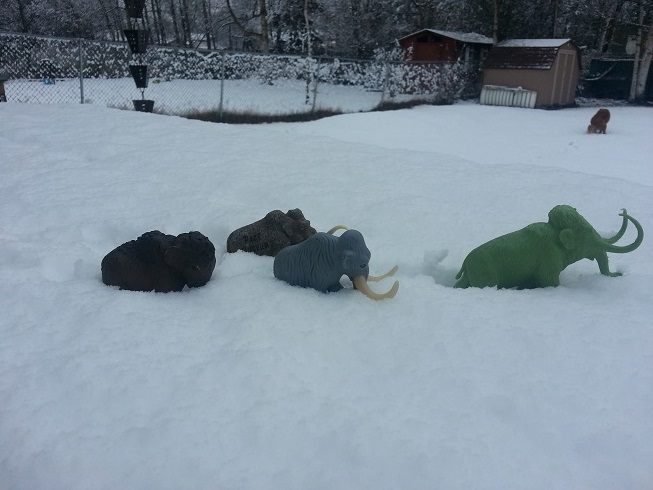
Meanwhile: here's a herd of mammoths trudging through a late spring snowfall.
Sunday, June 7, 2015
Monday, February 16, 2015
Why do I try?
In all my years of blogging, the post that got the most comments was the simple question "Am I the only one who still thinks of unlined paper as 'typing paper?'"
Today on Twitter, I repeated someone else's mild joke about President's Day and, so far, I've had fifty favorites and retweets, by far the most I've had for anything I've ever said.
Instead of spending all this time researching a book, I should have just gone on social media years ago, written "So, what's the deal with mammoths?" and appended a hashtag for Jerry Seinfeld. It would have instantly made me Mr. Mammoth throughout the internet and gotten me an appearance on the Tonight Show and a fifteen minute NPR feature.
Today on Twitter, I repeated someone else's mild joke about President's Day and, so far, I've had fifty favorites and retweets, by far the most I've had for anything I've ever said.
Instead of spending all this time researching a book, I should have just gone on social media years ago, written "So, what's the deal with mammoths?" and appended a hashtag for Jerry Seinfeld. It would have instantly made me Mr. Mammoth throughout the internet and gotten me an appearance on the Tonight Show and a fifteen minute NPR feature.
Monday, February 2, 2015
Sunday, October 5, 2014
Mammoth in a thong
In an effort to make science even sexier than it already is, Hope Jaren has introduced #ThingIStudyInAThong on Twitter. This is my contribution.
Mammoth in a thong. The real reason they went extinct?
Wednesday, August 6, 2014
Britannica breaks my heart
While hunting for some old images of moeritherium, I came across this:
Everything on it is wrong. Admittedly, the order Proboscidea has a big bushy family tree and many of the lineages and connections are the subjects of active controversies. But this goes beyond valid controversy; it's just wrong.
Starting at the bottom.
The genus Moeritherium is not the ancestor of any later proboscidean species. Though it had a nice long run of its own (almost twenty million years) and produced about a half dozen species, it was a side branch that ultimately left no descendants. When Charles W. Andrews unearthed the first Moeritherium at Fayum, Egypt in 1901, the oldest known proboscidean fossils were gomphotheres from the early Miocene. His discovery pushed the history of the order back to the earliest Oligocene--ten million years, but they didn't know that yet. It was an easy jump to make from earliest elephant to ancestor of elephants and Andrews announced his discovery that way. However, additional discoveries by him and by others soon raised questions about that conclusion and most Twentieth Century paleontologists were content to call it a cousin.
Trilophodon isn't a recognised genus or species at all. The word was coined in 1857 by Hugh Falconer to describe a sub-genus of mastodons that included the American mastodon and about half of the family that later came to be called gomphotheres. The other half, he called Tetralophodons (the terms describe an element of tooth architecture). The words are used today as adjectives, not as formal names, for different types of gomphotheres. The illustration is probably supposed to be Gomphotherium angustidens, the most common and best known Old World gomphothere.
Depending which species the Britannica artist had in mind, they might have managed to get the relationship somewhat right with Platybelodon. It is a trilopodont gomphothere. It produced the final species of the sub-family Amebelodontinae.
As far as mammoths being descended from platybelodons, no, just no. Mammoths are not descended from trilopodont gomphotheres or from tetralopodont gomphotheres or any kind of gomphothere. Their last common ancestor existed about 23 million years ago before the various prodoscidean genera left Africa.
Mammuthus primigenius, the woolly mammoth, is not the ancestor of modern elephants. In fact, it didn't evolve until long after the three surviving elephant species had reached their current forms. The idea that it is an ancestor originated in the earliest days of paleontology, before evolution or the ice ages were understood or accepted. Johann Blumenbach, who first recognized that mammoths were different enough from modern elephants to need a unique scientific, name thought of them as a less refined local breed of elephant and named them Elephas primigenius - the primal or original elephant. It didn't take long for naturalists figure out that the mammoth was different enough to need its own genus - Mammuthus. Outside of creationist literature, I'm not sure where you would find a source that claims mammoths are ancestral to elephants written since the 1880s at the latest. Plus woolly mammoths weren't that large. While they weighed as much African savanna elephants, they were much more compact, shorter and thicker.
African and Mammoth/Asian elephants diverged from each other about seven million years ago. Each of those lines produced several species before the modern ones appeared, coincidentally around the same time, 2.5 million years ago. Mammoths separated from Asian elephants while their common ancestor still lived in Africa.
To sum up: four relationships that are wrong, one species that never existed, one in the wrong chronological order, one visually incorrect (in size), and Asian elephants aren't blue. A correct illustration should look something like this:
When did Britannica become so sloppy?
UPDATE: An editor at Britannica just tweeted me to thank me for bringing the problem to their attention and to say they'll get right on fixing it. My faith is restored.
Everything on it is wrong. Admittedly, the order Proboscidea has a big bushy family tree and many of the lineages and connections are the subjects of active controversies. But this goes beyond valid controversy; it's just wrong.
Starting at the bottom.
The genus Moeritherium is not the ancestor of any later proboscidean species. Though it had a nice long run of its own (almost twenty million years) and produced about a half dozen species, it was a side branch that ultimately left no descendants. When Charles W. Andrews unearthed the first Moeritherium at Fayum, Egypt in 1901, the oldest known proboscidean fossils were gomphotheres from the early Miocene. His discovery pushed the history of the order back to the earliest Oligocene--ten million years, but they didn't know that yet. It was an easy jump to make from earliest elephant to ancestor of elephants and Andrews announced his discovery that way. However, additional discoveries by him and by others soon raised questions about that conclusion and most Twentieth Century paleontologists were content to call it a cousin.
Trilophodon isn't a recognised genus or species at all. The word was coined in 1857 by Hugh Falconer to describe a sub-genus of mastodons that included the American mastodon and about half of the family that later came to be called gomphotheres. The other half, he called Tetralophodons (the terms describe an element of tooth architecture). The words are used today as adjectives, not as formal names, for different types of gomphotheres. The illustration is probably supposed to be Gomphotherium angustidens, the most common and best known Old World gomphothere.
Depending which species the Britannica artist had in mind, they might have managed to get the relationship somewhat right with Platybelodon. It is a trilopodont gomphothere. It produced the final species of the sub-family Amebelodontinae.
As far as mammoths being descended from platybelodons, no, just no. Mammoths are not descended from trilopodont gomphotheres or from tetralopodont gomphotheres or any kind of gomphothere. Their last common ancestor existed about 23 million years ago before the various prodoscidean genera left Africa.
Mammuthus primigenius, the woolly mammoth, is not the ancestor of modern elephants. In fact, it didn't evolve until long after the three surviving elephant species had reached their current forms. The idea that it is an ancestor originated in the earliest days of paleontology, before evolution or the ice ages were understood or accepted. Johann Blumenbach, who first recognized that mammoths were different enough from modern elephants to need a unique scientific, name thought of them as a less refined local breed of elephant and named them Elephas primigenius - the primal or original elephant. It didn't take long for naturalists figure out that the mammoth was different enough to need its own genus - Mammuthus. Outside of creationist literature, I'm not sure where you would find a source that claims mammoths are ancestral to elephants written since the 1880s at the latest. Plus woolly mammoths weren't that large. While they weighed as much African savanna elephants, they were much more compact, shorter and thicker.
African and Mammoth/Asian elephants diverged from each other about seven million years ago. Each of those lines produced several species before the modern ones appeared, coincidentally around the same time, 2.5 million years ago. Mammoths separated from Asian elephants while their common ancestor still lived in Africa.
To sum up: four relationships that are wrong, one species that never existed, one in the wrong chronological order, one visually incorrect (in size), and Asian elephants aren't blue. A correct illustration should look something like this:
When did Britannica become so sloppy?
UPDATE: An editor at Britannica just tweeted me to thank me for bringing the problem to their attention and to say they'll get right on fixing it. My faith is restored.
Friday, July 11, 2014
Not a good way to go
Here's a little story on CT scans of the two baby mammoths
Khroma and Lyuba. The two are recent discoveries--found within the last
decade--and among the most complete and best preserved ever seen. With such
exceptional specimens, it's only natural that researchers would constantly be
searching for ways to squeeze a few more facts out of them. Getting an
opportunity to run one through an industrial-sized CT scanner is something both
teams jumped at. The article mentions some interesting lines of research suggested
by the results about how they grew and possible subspecies, but one thing stood
out for me: these babies died horrible deaths.
CT scans of Lyuba and Khroma showing the sediment they in
haled in their final moments. Source.
Most things that die go straight into the food chain. There
are billions of bugs, germs, fungi, roots, wolves, sharks, and birds waiting
for their share of anything that dies. If the biosphere has its way, no part
will go unused. But, the biosphere does not always get its way and that's the
only thing that makes paleontology possible. Some bodies or parts thereof
escape the food chain and linger long enough for us look at them long after
their parent species have been taken off the menu. There will always be gaps in
the fossil record because the processes that lead to fossilization are the
exception rather than the rule. Every fossil has a unique story to tell.
Over the last 320 years, fewer than eighty mammoths have
been discovered with soft parts preserved (seventy-five by my count). Many of
those were no more than a patch of skin with some hair and ligaments attached.
Until recently, only about half of those reported were recovered. Only
seventeen of the seventy-five were more than half complete when discovered. We
know details of the last moments of the lives of only a small number of
preserved mammoths. To my knowledge, all but one died a horrible, terrifying
death.
The CT scans of Khroma and Lyuba show they drowned, buried
in mud, and still gasping hard enough as they went under that they sucked
sediment into their lungs. Little Dima, though the story of his death is still
disputed, apparently stayed afloat for days in a bog before losing his strength
and sinking into the mud. The Berezovka mammoth, an old male, tumbled down a
riverbank, breaking his hip and thigh as he fell, and suffocated while
struggling to stand up as wet soil slid down the bank and buried him alive.
The taxidermied skin of the Berezovka mammoth in the posture
died in, attempting to rise as it was buried. Vladimir Gorodnjanski, 2007.
All of these horrible deaths were preserved because they
happened in the Fall. Once the mammoths died, they were quickly frozen,
probably that same night, and, for some reason, never thawed. In Lyuba's case,
her preservation was aided by settling into an anoxic layer of sediment in the
pond where she drowned. Other mammoth carcasses discovered at Yuribei and Fishhook
also show a pattern of having died in the late Summer or Fall.
Dutch paleontologist Dick Mol with the head of the Yukagir
mammoth. Source.
I'm only aware of one frozen mammoth that died in the Spring
and, coincidentally, he's also the only one I'm aware of who died a peaceful
death. The Yukagir mammoth was discovered in 2002 on the banks of an oxbow lake
east of the Lena River delta. The front part of the body and most of the gut
with its contents were recovered and sent to Yakutsk to be studied. The Yukagir
mammoth was an old male who died in the early Spring after a tough Winter. He
had several deformed vertebrae in his upper back from an infection indirectly
caused by inflammatory bowel disease. It was the hungry season just before the
plants would begin to bud and bloom. He had been eating a lot of willow twigs,
which do not have a very high nutritional value, but they would have filled his
stomach and the natural aspirin in them would have soothed his back. It was
probably a warm day when he lay down on the shady side of a hill and died.
Later, the sun melted some mud higher on the hill which covered the body and
froze. Being on the shady side of the hill, it stayed frozen for the next
twenty-two thousand years.
That most of the frozen mammoths died in the late Summer or Fall, is not an observation that can be extended as a rule to other fossils. This season was the time of year when large animals on the mammoth steppe had the best odds of being preserved, that is covered in mud and frozen. Other environments had their own best seasons for preservation. I suspect the best time to get preserved in the anoxic depths of a peat bog would be the wettest season. The best time to get deeply buried in sediments of a lake or shallow sea would be the flood season. The least likely time of year for preservation, in any environment, would be any time that left a body exposed on the surface where scavengers and the elements could have their way with your remains.
Saturday, May 17, 2014
The Periodic Table of the Elephants
Last January, Brian Switek, a rising star in the dinosaur firmament (his latest book), made an offhand comment about the need for a periodic table of the elephants. I don't know if he meant it seriously or if he was just going for the pun. However, I had just been reading about proboscidean evolution and the name set off a whole marquee of light bulbs over my head. Let's make a periodic table of proboscidean evolution.
I Googled the idea and found several "Periodic Tables of the Elephants" but all of them were normal periodic tables using cartoon elephants as illustrations. None of them were really about elephants. I let the idea bubble for a while, bounced it off my Facebook friends, and, last week, decided to go for it.
So, what is the plan? Simply put, it's an educational poster of proboscidean evolution using the familiar theme of the periodic table to illustrate the diversity of the proboscidean family tree. It's a very bushy tree. The definitive work in the late 1930s listed 350 species. It took sixty years for someone to become brave enough to prune that tree, getting rid of unnecessary duplications, and adding recent discoveries. By my count, there are currently 177 species recognized in the order Proboscidea. This can't all be explained in a poster. No one wants a poster of mostly words. The poster needs an accompanying booklet. This book and poster set is not unusual for educational posters.
Alrighty. What's the plan? For the periodic table itself, I intend to organize a representative subgroup of the recognized species (about a third of them) in the order that their genera first appeared in the fossil record and use these for the table. For each square in the table, I'll make a drawing of the species with a size bar, give it a two letter symbol, provide its Linnean binomial (scientific name), and the namer and year it was named (these are also part of the full scientific name). In the center of the poster I'll provide a key to the squares and on one side I'll provide a general family tree of to show how they fit together.
But wait, that's not all. The booklet expands on this. In the booklet I'll provide a specific description of each species, with an enlarged illustration, explaining it's evolutionary significance and stories about it's discovery, lifestyle, and appearance. The whole thing will be prefaced with an illustrated article on proboscidean evolution that gives perspective to each of the individual genera and species. Aside from its educational value, the booklet will allow the owner to assume an air of superiority while explaining the poster to their students/nerdy friends. Who doesn't like that?
I've decided to pitch this on Kickstarter (or Indiegogo, I'm open to recommendations). I'm broke and I need some income to keep going. I have tons of research that doesn't fit into the book, and I would like to monetize it. This also gives me something to put on my resume to convince potential publishers that I know my stuff. There are some great stories that I had to greatly abridge or cut from the book. These will make great e-books, but these are things that will be useful for marketing the mammoth book after it's done. I need something that I can do right away that will pay up front. The evolutionary data fits the ticket perfectly.
To do this, I'll need to produce around eighty professional quality illustrations. I can do that, but, since the last time I did any serious illustration, I've developed a serious hand tremor. Retraining myself will take some work, but not a lot. I would show you my current artistic ability, but my scanner died not long before I moved. Getting a new one will bee my first expense. I need to pay myself for my research time, my art, layout, color, and the production of the first batch of the posters, booklets, associated mailing costs, and anything I might have missed. Based on what I've already done, I think three months for the project is a realistic goal.
This leads me to some questions: 1) Is this a good idea? 2) Would you buy the poster or do you know anyone who would? 3) If I go ahead with this, what should be my financial goal? I think at least $4000 for the art and at least $2000 for the rest. Could I get more? 4) I need to offer threshold gifts. Any ideas? Signed prints? The poster? 5) What am I forgetting?
I'll keep working on the book during this time, just not as fast. If anyone has experience with Kickstarter projects, I'd love to hear about it. What do you think?
I Googled the idea and found several "Periodic Tables of the Elephants" but all of them were normal periodic tables using cartoon elephants as illustrations. None of them were really about elephants. I let the idea bubble for a while, bounced it off my Facebook friends, and, last week, decided to go for it.
So, what is the plan? Simply put, it's an educational poster of proboscidean evolution using the familiar theme of the periodic table to illustrate the diversity of the proboscidean family tree. It's a very bushy tree. The definitive work in the late 1930s listed 350 species. It took sixty years for someone to become brave enough to prune that tree, getting rid of unnecessary duplications, and adding recent discoveries. By my count, there are currently 177 species recognized in the order Proboscidea. This can't all be explained in a poster. No one wants a poster of mostly words. The poster needs an accompanying booklet. This book and poster set is not unusual for educational posters.
Alrighty. What's the plan? For the periodic table itself, I intend to organize a representative subgroup of the recognized species (about a third of them) in the order that their genera first appeared in the fossil record and use these for the table. For each square in the table, I'll make a drawing of the species with a size bar, give it a two letter symbol, provide its Linnean binomial (scientific name), and the namer and year it was named (these are also part of the full scientific name). In the center of the poster I'll provide a key to the squares and on one side I'll provide a general family tree of to show how they fit together.
But wait, that's not all. The booklet expands on this. In the booklet I'll provide a specific description of each species, with an enlarged illustration, explaining it's evolutionary significance and stories about it's discovery, lifestyle, and appearance. The whole thing will be prefaced with an illustrated article on proboscidean evolution that gives perspective to each of the individual genera and species. Aside from its educational value, the booklet will allow the owner to assume an air of superiority while explaining the poster to their students/nerdy friends. Who doesn't like that?
I've decided to pitch this on Kickstarter (or Indiegogo, I'm open to recommendations). I'm broke and I need some income to keep going. I have tons of research that doesn't fit into the book, and I would like to monetize it. This also gives me something to put on my resume to convince potential publishers that I know my stuff. There are some great stories that I had to greatly abridge or cut from the book. These will make great e-books, but these are things that will be useful for marketing the mammoth book after it's done. I need something that I can do right away that will pay up front. The evolutionary data fits the ticket perfectly.
To do this, I'll need to produce around eighty professional quality illustrations. I can do that, but, since the last time I did any serious illustration, I've developed a serious hand tremor. Retraining myself will take some work, but not a lot. I would show you my current artistic ability, but my scanner died not long before I moved. Getting a new one will bee my first expense. I need to pay myself for my research time, my art, layout, color, and the production of the first batch of the posters, booklets, associated mailing costs, and anything I might have missed. Based on what I've already done, I think three months for the project is a realistic goal.
This leads me to some questions: 1) Is this a good idea? 2) Would you buy the poster or do you know anyone who would? 3) If I go ahead with this, what should be my financial goal? I think at least $4000 for the art and at least $2000 for the rest. Could I get more? 4) I need to offer threshold gifts. Any ideas? Signed prints? The poster? 5) What am I forgetting?
I'll keep working on the book during this time, just not as fast. If anyone has experience with Kickstarter projects, I'd love to hear about it. What do you think?
Thursday, May 15, 2014
The turquoise teeth of Languedoc
Although paleontology, as a defined science, has only been
around for two hundred years, digging up fossils and trying to make sense of
them far predates recorded history. In the 1880s, French archaeologists
discovered a much-handled, trilobite fossil that had been drilled as if to be
worn as a pendant. The occupation level in the cave where it was found has been
dated to be fifteen thousand years old. For the bones of large extinct mammals,
a small number explanations and uses have existed during the era of written
history. The bones have been seen as the remains of human giants, monsters,
unknown animals, and as mineral productions that merely resemble real bones.
They have been used to inspire the faithful, as medicine, and, in Europe, as a
source of turquoise.
On November 25, 1715, thermometer pioneer and all around
smart guy, René Antoine Ferchault de Réaumur presented a paper at a public
meeting of the French Academy regarding turquoise mines in Languedoc, the
southwestern part of the kingdom. The mines, he said in passing, had been idle
for twenty years due to wars and other disruptions. Before the paper was published,
it was brought to the attention of Philippe II, Duke of Orleans, and newly
installed regent for the five year old king, Louis XV. As regent, Philippe had
the responsibility of finding resources to pay for those recent wars. Réaumur
noted in the published version of his paper that, in the year since he had
presented the paper, the Regent sent one of the members of his cabinet, Gilbert
Charles le Gendre, to investigate. The governor of Languedoc was ordered to give
his full cooperation and see if the mines could be brought back into production.
The aqua colored stone called turquoise was known and used in
Europe in the same way as other precious stones. Most great collections
included jewelry and religious items decorated with polished pieces of
turquoise. Though the stone was well known, there was a great deal of confusion
about its nature. The word "turquoise" was a fairly recent coinage meaning,
essentially, "the Turkish stone." Turquoise originated somewhere in the East
and was imported into the West by Turkish merchants. The problem with the name
was that the Turks had not been between Europe and the Far East for that long.
The Turks came from Central Asia. For centuries, Turkish tribes had been
relocated by the Persian kings to their western frontier to serve various
geopolitical purposes that are interesting, but not relevant here. By the early
Second Millennium, they had become numerous enough and had Turkicised enough of
the neighboring population that they began to form states independent of the
Persian Empire. The identification of turquoise with the Turks probably dates
to the Fourteenth Century when the Persians began to exploit new mines near
Nishapur creating a dependable supply for export.
None of the writers of Réaumur’s time thought that turquoise
was a new substance. The natural historians of Antiquity, such a Pliny and
Theophrastus, described several blue and blue-green stones whose modern
identity was uncertain. For the later naturalists, the relevant question was which,
if any, of those stones referred to turquoise? Réaumur identified two possible
contenders in Pliny’s Natural History: one called borea and the other calais. The
belief of his peers was that, during the thousand years between the fall of
Rome and the arrival of Nishapur turquoise, whatever word the ancients had used
for the stone had fallen into disuse and been forgotten. When Turkish merchants
began offering it as a new commodity, European merchants, lacking another name,
called it the Turkish stone. The etymology suffered some problems, such as: why
didn't anyone ask the Turks what it was called. Additionally confusing was the
fact that the earliest known use of the word "turquoise" slightly preceded the
arrival of the Nishapur stones in Europe and had been used to describe a
different stone—a yellow-white one—being imported from the East by Turkish
merchants.
The uncertain historical identity was followed by a second
problem, which was particularly important to Réaumur. He wanted to know whether
Persian turquoise and Languedoc turquoise were the same substance. This turned
out to be a very complicated problem. The ancient writers being of no help, he combed
through more recent writers to find an answer, but found them just as confused
as he was. The writers he cites in his paper describe two types of turquoise:
Oriental, meaning Persian, which was regarded as being the best quality, and
Occidental, found in parts of Europe, and which was regarded as being of lower
quality. The French traveler and gem merchant Jean-Baptiste Tavernier, who is best
known today for having brought the great blue gem we call the Hope Diamond to
Europe, spent considerable time in Persia and knew something of the mines
around Nishapur, though he did not personally visit them. He wrote that there
were two different mining districts and that each produced a different type of
stone. The harder, bluer stone was called "old rock" and the softer, paler
stone was called "new rock." Finally, there were reports of blue stones
occasionally turning up in the New World. Oriental hard rock, Oriental soft
rock, European, and American stones were at one time or another all called
turquoise, but were they all the same stone?
The lecture Réaumur presented to the Academy was
significantly different from the paper published in their journal almost two
years later. The published paper contained additional information Though a copy
of the lecture has not survived, Réaumur was fairly clear about which details
were c he learned after the lecture thanks to Gendre's investigations as an
agent of Philippe II. Réaumur says that he never was able to visit the mines in
person; his original presentation must have been entirely based on written
sources. None of these sources had a lot to say about Languedoc turquoise, but
they all mentioned one curious detail that did not appear in other descriptions
of the stone. Languedoc turquoise did not come out of the ground showing the
bright blue color that made the stone so desirable. To achieve that color, it
had to be treated with fire. Gendre provided Réaumur with samples from the
mines to experiment on. The samples surprised him. Several of them looked like
very large teeth.
Two of the teeth Réaumur examined. He handled at least six complete teeth and several fragments. Source.
Along with his purely scientific interest, Réaumur had a
very practical reason for looking into the mines. For five years he had headed
a committee charged with cataloging the useful arts and manufactures of the
kingdom. Even after his work on the committee was completed, for the rest of
his life he maintained an acute interest in the practical application of the
sciences for the good of the realm publishing papers on beekeeping, silk
production, and iron smelting. It’s likely that the first draft of his paper
was an official report and that this was how the mines came to the attention of
Philippe and Gendre.
A significant part of Réaumur’s paper was dedicated to the
mines themselves and the method of converting the stones into turquoise. The
earliest mention he could find for the mines was from 1628 and the locals said
that they had been idle for about twenty years, though they were starting to
come back into production. Most of the mines were near the town of Simore in
the Gers district of Lower Languedoc. The turquoise was found in a layer of
bluish sand several layers below the surface. The mines had to be heavily
timbered because of the sandy soil. Some mines were as deep and fifty feet deep
and he believed that there was plenty of turquoise still to be found. When
discovered in the ground, the turquoise pieces were light yellow, tan, or light
blue. To become turquoise, the pieces needed to be baked in special ovens that
were a little larger than a coffin. Once the fire created a good bed of coals,
the pieces were placed in a small cup, which he called a shoe (sabot), and
placed on a ledge in the oven. The stones and the oven required constant
attention. Wood had to be added to keep the temperature high and the unripe
turquoise needed to be regularly monitored for color. The time needed to reach
the best color ranged from less than four hours to over twenty four. If left in
the oven for too long, the pieces would first turn green and then black,
neither of which had any commercial value.
The ovens and tools for preparing the turquoise. Source.
In going over literature that specifically mentioned
Languedoc turquoise, Réaumur saw that, of the five sources he discovered (I
haven’t found any more), three mentioned the necessity of fire in bringing out
the color and two mentioned fact that the turquoise ore looked like bones. His
contemporary informants told him that the locals even referred to pieces as
arms, legs, and teeth. He examined the pieces that had been sent to him with
very carefully with a microscope and saw minute structures that convinced him
that the ore really was the petrified remains of bones and teeth and not just
rocks that looked like them. There was enough variation among the teeth that he
suspected they were the remains of more than one species of animal. For a man
of science, he showed very little curiosity about what those species might have
been. In two sentences he says they are probably the remains of kind of sea
animal since nothing similar lives on the land and leaves it at that.
There was a good hint to the identity of one of the animals
in the earliest description of the Languedoc turquoise. In 1728, Guy de la
Brosse wrote in his On the Nature, Virtue, and Utility of Plants: “There is a
stone that has figure of a horn, the consistency of stone, and, exposed to
graduated heat, gives true Turquoise: it is called unicorn mineral (Licorne
minerale), because it looks like the horn of an animal. It is effective against
all kinds of poisons.” The unicorn mineral, also known as unicornu fossile and
ebur fossile, was the name given to fossil ivory, which almost always meant
tusks of mammoths or of a few other species of prehistoric elephant. Since
antiquity, unicorn horns had been believed to be an antidote for all poisons
and even to have the power to detect poisons nearby. During the poison panic of
the Renaissance, narwhal teeth were worth considerably more than their weight
in gold. There was some question about whether fossil ivory came from unicorns
or some other animal, but there was little doubt that it had the same
anti-poison properties. In de la Brosse’s time the belief that the only
security against the poisoners that lurked behind every tapestry was a large
piece of unicorn horn had begun to fade. The price had been dropping since the
last years of the previous century though the belief that powdered unicorn horn
was good medicine hung on in some circles right up to Réaumur’s time. His lack
of interest in the animal that produced the Simore teeth is curious because,
when he made his investigations, it was generally accepted that most fossil
ivory came from elephants and not sea creatures. Testing modern ivory to see if
it too could be converted into turquoise would have been an obvious line of
research for him to pursue.
Having blown off the question of whose teeth the Languedoc
turquoise came from, Réaumur was left with one final question: was this the
same substance as Persian ivory; were the Persians also baking bones and teeth
to get turquoise? Réaumur took a selection of stones to a Paris jeweler who was
familiar with Persian turquoise. The jeweler told him that some of the stones
were old rock and some of them were new rock. If Tavernier was to be believed,
this shouldn't have been possible. The two should not be found together in the
same place. The jeweler held firm in his identification. Réaumur's microscopic
examinations revealed that Persian turquoise did not show any of the organic
structures that he saw in his samples from Simore. He was confident that his
turquoise was a different substance than Persian turquoise. He expressed no
opinion on the question of whether or not old rock and new rock Persian
turquoise were the same substance.
Réaumur's paper was influential, but not the last word on
the topic. In Bordeaux, local officials experimented with baking newer bones in
the hope of producing their own turquoise. The experiment was a failure. For
the next century, various writers argued about whether or not the Languedoc
stones were “real” turquoise. Interest in the stones finally waned in the early
Nineteenth Century when Gotthelf Fischer from Moscow University made a study of
various turquioses and named the French turquoise odontolite. Now that it had a
name, the stone went out of fashion. The main academic interest in it was
nailing down exactly which chemicals, assumed to be metals, gave odontolite its
color. It was a frustratingly elusive problem only solved in the Twenty-first
Century.
Réaumur donated four of the teeth to the royal collections. They
are the same ones he used as illustrations for his paper. He must have kept
those. When Louis-Jean-Marie Daubenton organized and cataloged the collections
in the 1750s and ‘60s, he placed the teeth with hippopotamus bones. It was an
inspired error. He also cataloged mastodon teeth from North America as
belonging to hippos. He believed that both sets of teeth came from a giant,
unknown species of hippo. The two were related to each other, but not to
hippos. In 1796, Georges Cuvier, a rising young star in the French scientific
scene, confidently announced to the world that mammoths and mastodons were not
elephants, they were two extinct species only related to elephants. Extinction
was a controversial idea at the time. Cuvier became an unofficial keeper of the
list for extinct animals. In 1806, after examining Réaumur’s turquoise teeth in
what was now the national museum, he added a new species to the list. He called
it Mastodon angustidens. Over the years, the species has been bounced from
genus to genus; today it’s called Gomphotherium angustidens. Three of the teeth
in the museum came from this species and it is by far the most common
proboscidean fossil in Languedoc.
Reconstruction of G. angustidens by Charles R. Knight. Notice the long jaw and four tusks. Source.
Though the Simore mines no longer produce turquoise, the
digging hasn't stopped there. With the science of paleontology taking off,
French scientists traveled to the region to hunt for ancient bones. During the
Nineteenth Century, Edouard Lartet worked in the region and found bones from
ninety-eight different genera of mammals, some extinct and some still living.
Others followed. Lower Languedoc, it turns out, is a treasure chest of Miocene
fossils. The Miocene ran from 23 to 5.3 million years ago. G. angustidens lived
during the latter half of that. Many other species have been discovered in the
region including other proboscideans. Fossil bones are plentiful enough there
that, sooner or later, paleontologists would have begun to dig there even without
Réaumur's guidance. As it was, it was sooner, and all because he became curious
about reports of turquoise around the town of Simore and asked questions.
Thursday, April 10, 2014
Book update
Today I received another rejection, or semi rejection, letter. The editor wrote that it sounds like an interesting project and invited me to submit the completed manuscript when it's ready. I read that to mean she thinks the concept has potential, but is not willing to risk an advance on a writer with no publication history or academic credentials. Crap.
The problem, at this point, is that there just aren't that many well distributed publishers of non-fiction that will consider unsolicited proposals. My next move will be to:
A. start submitting to smaller university and regional presses or
B. look for an agent.
Both of these probably represent a reduction in profit and money is an object for me. I've spent seven years on this and, being broke and unemployed, I would like to make enough to live on while I finish it and maybe even be able to get an apartment.
Tessa had an old Peanuts cartoon that we kept on the fridge door. Snoopy was sitting on his doghouse typing. The caption reads: "Dear sirs, With regards to your rejection letter. What I wanted was for you to send me fifty thousand dollars and publish my book. Didn't you know that?" Apparently they don't.
The problem, at this point, is that there just aren't that many well distributed publishers of non-fiction that will consider unsolicited proposals. My next move will be to:
A. start submitting to smaller university and regional presses or
B. look for an agent.
Both of these probably represent a reduction in profit and money is an object for me. I've spent seven years on this and, being broke and unemployed, I would like to make enough to live on while I finish it and maybe even be able to get an apartment.
Tessa had an old Peanuts cartoon that we kept on the fridge door. Snoopy was sitting on his doghouse typing. The caption reads: "Dear sirs, With regards to your rejection letter. What I wanted was for you to send me fifty thousand dollars and publish my book. Didn't you know that?" Apparently they don't.
Saturday, April 5, 2014
South Carolina has a State Fossil
South Carolina finally has an official state fossil: the Columbian mammoth (that's also the state fossil of Washington). The decision was not without some melodrama.
As I mentioned below, eight year old Olivia McConnell was perusing lists of state symbols and noticed that her state was one of the last states without a state fossil. She did some research and discovered that South Carolina has a special tie to American paleontology through a discovery of some mammoth teeth that were the first in the New World to be authoritatively identified as elephantine in nature. The identification was made by an African slave whose name was unfortunately not recorded. Armed with this background research, Olivia wrote to her state representatives who promptly wrote a bill and submitted it to each house. The bill was short and clear. After the usual whereas's it read:
If the story had simply been about religion, Bryant and his supporters would have gotten their Southern stubborn on and said "screw you" to Yankees, the liberal media, and all of the others that they imagine to be persecuting them. The South Carolina legislature has had no problem unconstitutionally inserting religion into their education standards. What made this time different was that the story was almost universally framed as "humorless old men frustrate well-meaning little girl's dream." Defying public opinion in the name of God and the South wasn't going to work this time. Bryant whined to The Daily Beast that he didn't mean to block Olivia's bill, he "just felt like it'd be a good thing to acknowledge the creator of the fossils."
The simple thing to do would have been for Bryant to remove his amendment and pass the bill before the PR disaster could go on any longer. It didn't work out that way. Bryant removed his amendment, but Sen. Mike Fair, another creationist, put a hold on the bill so Bryant could reword his injection of religion in a way that wouldn't be deemed a new topic. Bryant did this and the Senate leadership accepted his new language. The bill was set to come up for a vote on Wednesday, when Senate Majority Leader Harvey Peeler blocked it. Peeler thinks the state has more than enough state symbols and considers naming any more to be a waste of time. To demonstrate how strongly he felt about this, he chose the most embarrassing time possible to waste three hours of the Senate's time arguing over it. Finally, the leadership allowed his to insert a second clause into the bill declaring a moratorium on any new symbols. The leadership chose not to view this as a new topic even though it is. The final vote was unanimous.
The final Senate bill is hardly perfect. Peeler got his moratorium. Bryant got his religion. The final wording is awkward and redundant:
South Carolina has a state fossil and Olivia McConnell has had an education in civics. I hope this encourages her to stay out of politics and to go into science. Or, if she is inspired to go into politics, that it be so the people of South Carolina have someone representing them who knows how to do their homework and who will cut through the crap.
As I mentioned below, eight year old Olivia McConnell was perusing lists of state symbols and noticed that her state was one of the last states without a state fossil. She did some research and discovered that South Carolina has a special tie to American paleontology through a discovery of some mammoth teeth that were the first in the New World to be authoritatively identified as elephantine in nature. The identification was made by an African slave whose name was unfortunately not recorded. Armed with this background research, Olivia wrote to her state representatives who promptly wrote a bill and submitted it to each house. The bill was short and clear. After the usual whereas's it read:
Article 9, Chapter 1, Title 1 of the 1976 Code is amended by adding: "Section 1-1-712A. The Columbian Mammoth is designated as the official State Fossil of South Carolina."It sailed through the House with a 94-3 vote, went on the Senate, and came screeching to a halt. Sen. Kevin Bryant, a creationist, decided the bill needed some religion and amended it with three verses from Genesis describing the creation of the animals. This was judged to be an insertion of a new topic into the bill which, for procedural reasons stopped its progress. At this point, the national press took notice, and not in a way that made South Carolina look good.
If the story had simply been about religion, Bryant and his supporters would have gotten their Southern stubborn on and said "screw you" to Yankees, the liberal media, and all of the others that they imagine to be persecuting them. The South Carolina legislature has had no problem unconstitutionally inserting religion into their education standards. What made this time different was that the story was almost universally framed as "humorless old men frustrate well-meaning little girl's dream." Defying public opinion in the name of God and the South wasn't going to work this time. Bryant whined to The Daily Beast that he didn't mean to block Olivia's bill, he "just felt like it'd be a good thing to acknowledge the creator of the fossils."
The simple thing to do would have been for Bryant to remove his amendment and pass the bill before the PR disaster could go on any longer. It didn't work out that way. Bryant removed his amendment, but Sen. Mike Fair, another creationist, put a hold on the bill so Bryant could reword his injection of religion in a way that wouldn't be deemed a new topic. Bryant did this and the Senate leadership accepted his new language. The bill was set to come up for a vote on Wednesday, when Senate Majority Leader Harvey Peeler blocked it. Peeler thinks the state has more than enough state symbols and considers naming any more to be a waste of time. To demonstrate how strongly he felt about this, he chose the most embarrassing time possible to waste three hours of the Senate's time arguing over it. Finally, the leadership allowed his to insert a second clause into the bill declaring a moratorium on any new symbols. The leadership chose not to view this as a new topic even though it is. The final vote was unanimous.
The final Senate bill is hardly perfect. Peeler got his moratorium. Bryant got his religion. The final wording is awkward and redundant:
The Columbian Mammoth, which was created on the Sixth Day with the other beasts of the field, is designated as the official State Fossil of South Carolina and must be officially referred to as the 'Columbian Mammoth', which was created on the Sixth Day with the other beasts of the field.
The one improvement, from my perspective, is that they finally got the species right. The original bill said "Wooly (sic) Mammoth" in the title and "Columbian Mammoth" in the actual bill. The final version has this corrected to Columbian in both places. The press is still having trouble with that. The New York Times coverage refers to it as the "Columbia woolly mammoth." USA Today correctly refers to it as the Columbian mammoth, but then messes up by calling it a sub-species of the woolly mammoth.
South Carolina has a state fossil and Olivia McConnell has had an education in civics. I hope this encourages her to stay out of politics and to go into science. Or, if she is inspired to go into politics, that it be so the people of South Carolina have someone representing them who knows how to do their homework and who will cut through the crap.
Subscribe to:
Posts (Atom)


