Saturday, February 18, 2012

The Monsters of Islandia

Last fall while researching my article on images of walruses and possible mammoths on Renaissance maps, I looked at dozens of maps before finding the five I finally used. This was more fun than anyone deserves to have. I wasn't able to find excuses to use all of my research at the time. During the next few months, I'll put together a couple of less polished pieces so that I can share some off the more interesting tidbits that I found. One of the most fun maps that I found was Abraham Ortelius' Islandia, Iceland.

Ortelius is an important figure in the history of cartography. He is regarded as the father of the modern atlas. His Theatrum Orbis Terrarum was a bound volume of maps, with descriptive text, intended to sytematically cover the entire world. It came out in many editions and languages between 1570 and 1612 and was generously plagiarised then and later. The map Islandia first appeared in the edition of Theatrum in 1587. Islandia was the first detailed and accurate (by the standards of the time) map of Iceland. The information for the map itself originated with Bishop Gudbrandur Thorlaksson who sent it to a Danish historian, Anders Sörensen Vedel. Vedel sent the notes and a map of his own creation to Ortelius who used them used when preparing the copperplates for Islandia. The Vedel map has not survived. Many of the placenames on the map were badly mangled by Ortelius when he converted the Icelandic script (Latin letters with additional characters) into the Latin script common in Holland.


Islandia, printed in Antwerp, 1603.

I don't intend to write a detailed article about the map as a whole, today. I just want to make some comments about the animals surrounding the island in the sea, especially his sources for the animals. The auction site of Barry Lawrence Ruderman (my source for the Ortelius images) says:
Some of the more purely fanciful images may derive from tales of St. Brendan, a sixth century Irish missionary who, according to legend, journeyed to Iceland and whose name is associated with a mythical island of the same name. Others are traceable to Olaus Magnus's Carta Marina of 1539, although they were probably derived directly from Munster's Cosmographia of 1545 and most notably Munster's chart of the Sea and Land Creatures[Meerwunder und seltzame Thier].


Olaus Magnus' Carta Marina, printed in Venice, 1539.


Münster's Meerwunder und seltzame Thier, printed in Basel, 1552.

As far as I can tell, this is true, though I have identified some of the other sources. I believe Ortelius relied more directly on Olaus that on the intermediary of Münster. Only a few of the beasts on Islandia were portrayed in Cosmographia, while several more can be found on Olaus' map and, more importantly, in his book Historia de gentibus septentrionalibus, first published in 1555 and many times thereafter. Another source that Ortelius used was Konrad Gesner (De Piscibus Orbiculatis 1558), who commented on and, in some places, corrected Olaus. One of those corrections appears on Islandia. Finally, he might have used Ambroise Paré's Des Monstres. Although there is nothing in this that he couldn't have found in any of the other sources, Des Monstres first published in 1573, is one of the greatest monster bestiaries of all time.

On to the illustrations. Ortelius marked the animals on the map with capital letters. These were described in text on the back of the map. For each animal, I'll start with the image and description, follow with some possible sources for the image, and end with any other comments that wander into my mind.

A. is a fish, commonly called NAHVAL. If anyone eats of this fish, he will die immediately. It has a tooth in the front part of its head standing out seven cubits. Divers have sold it as the Unicorn's horn. It is thought to be a good antidote and powerful medicine against poison. This monster is forty ells in length.

From the description, it's quite clear that he intends a narwhal. I've written before about the European belief in unicorn horn. By the time that Ortelius wrote the text for this map, the belief in an actual unicorn animal was fading. However, belief in the horn itself, whatever its true source, and its anti-poison properties hung on for another century. Curiously, although there were plenty of images of sea unicorns that Ortelius might have drawn on, he chose to use something that resembles a swordfish to represent the narwhal. I haven't been able to locate a source for this image.

The ell is a highly flexible measure. It most commonly means, either a cubit (half yard, finger tips to elbow, or roughly eighteen inches) or a three-quarter yard (finger tips to arm pit, or roughly twenty-seven inches). Just to keep things confusing, it was also used for any foreign measure of the same order of magnitude.

Since I can't find anything to match his narwhal, we'll move on to B and C.

B. the Roider is a fish of one hundred and thirty ells in length, which has no teeth. The flesh of it is very good meat, wholesome and tasty. Its fat is good against many diseases.

C. The BURCHVALUR has a head bigger than its entire body. It has many very strong teeth, of which they make chess pieces [some editions say bricks]. It is 60 cubits long.

I don't have anything to offer for the images of B or C either. Their basic forms, with the wide open mouthes, vaguely matche standard artistic representations of fish going back to Minoan Greece. One thing I can say about the Burchvalur is that the description of a long head and teeth used for carving sounds like a sperm whale. In fact, several of the monsters on the charts of Ortelius, Olaus, and Münster are based on different stories about sperm whales.

On a linguistic note: Roider or reydur or reidr is an old Icelandic name for baleen whales, which have no teeth. The suffix -valur, in Burchvalur, comes from the root as "whale." It shows up as hvalur, wal, ual, hval and other forms hidden in the names of many northern sea mammals.

For D, I do have some meat. Ortelius points to Olaus as his source for the sea hog. Olaus bases his pig-like monster of the German Sea on a specific sighting in 1537. Between Olaus' first representation in 1539 and Ortelius' image in 1587, the beast has undergone some evolution.

D. The Hyena or sea hog is a monstrous kind of fish about which you may read in the 21st book of Olaus Magnus.

This first is from Olaus' 1539 map. The sea hog has a boar's head, a very scaly body, webbed feet, what might be a row of uneven spines or bristles on its back, horns like a cow's over its shoulders, and, strangest of all, what appear to be three eyes on its side.


Münster's version from six years later has fewer details. The webbed feet now look more like fins and the side eyes are gone. Where Olaus' sea hog faced right, Münster's faces left. This reversal was common when prints were copied. The engraver set the original work next to his plate and copied what he saw, forgetting, or not caring, that when his plate was printed, the image would become reversed.


The version printed in Olaus' book in 1555, faces left again. My guess is that Olaus' engraver worked from the map plates rather than a print. The image is a little more detailed and has a new background but it is otherwise unchanged.


In Gesner, three years later, the image is reversed, it's slightly more detailed (beautifully so), and lacks a background. In case there was any question about where he got the image, he directly quotes Olaus' book and comments on it.


Finally, we have Paré in 1573. The image face left and lacks any background, so I think it's safe to say it was copied from Gesner.
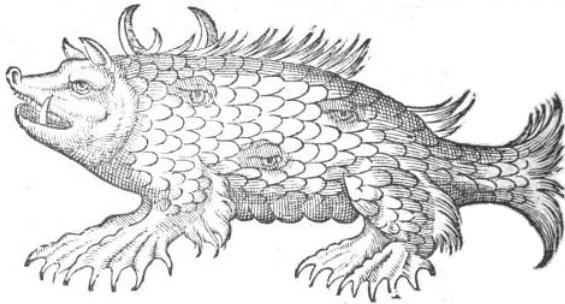

Looking back at Ortelius' image, I think it's clear that he did not get it from Münster. The most important in my making this judgement is the three side eyes. Münster did not have them, and does not mention them in his accompanying text. He merely calls it a "monstrous fish that resembles pig." In Ortelius, they look more like bullet holes that eyes, but they are there and in the same arrangement (two above one below). My principle of reversals would seem to argue that Ortelius worked from Olaus and not Gesner, but I think one other point argues in Gesner's favor. Ortelius' image is not a simple copy; it has been completely reworked. The scales are gone and the beast looks furry. The feet are no longer webbed; they look like those of a dog or some other terrestrial carnivore. In fact, he calls it a hyena. Gesner was the only previous writer to use the word hyena to describe the monster. I'm not sure where he picked up that reference. It's possible that there is another source that I'm not aware of that had an image of a furry sea hog, but until I hear of it, I'm going to say Ortelius was the one who improved the sea hog based on Gesner's description.

E. Ziphius, a horrible sea monster that swallows a black seal in one bite.

Various sources I've looked at claim that the Ziphius is a goose-beaked whale, a sperm whale, or an orca. Olaus, who first used the image was very clear that Ziphius is a swordfish (xiphia). He wrote that is had horrible eyes, a sharp beak like a sword, a triangular back (a fin), and that it was a stranger in the North that only occasionally showed up as a robber. However, he also said it had a head like an owl's and he drew it that way. Here are the images of Olaus, 1539; Münster, 1545; Olaus, 1555; and Gesner, 1558.


Three things stand out when comparing Ortelius' Ziphius with Olaus' first image. First, the second attacking monster is missing from the scene. Second, Ortelius' Ziphius has no dorsal fin. Third, it looks like Vincent van Gogh. I think the last one is a coincidence. Ortelius' Ziphius most closely matches Münster's. Of the four earlier images, only Münster's lacks the dramatic staging and it has the smallest dorsal fin. These make it the most likely source for Ortelius' Ziphius.

F. The English whale, thirty ells long. It has no teeth, but its tongue is seven ells in length.

Several things stand out taking this image and description together. First, it appears to have teeth, contrary to the description. Second, it has arms. Third, is that a giant penis? All of these details come from Olaus and are repeated in Gesner and partially in Paré.

Olaus' illustration is not based on a species called the English whale. It is, rather, an illustration for a report of a particular whale that beached itself near the mouth of the Thames on August 27, 1532. He describes the proportions of the whale, commenting on the fact that its mouth was long in proportion to its body. He says that is had long "wings," half the length of its body. He says it had no teeth but, instead, hairy blades on the roof of its mouth and a long tongue. He says that its genitals were of monstrous magnitude. I think most modern people would have no problem recognising this as a male baleen whale of some sort. Olaus' illustration shows workers chopping up the stinking carcass to dispose of it. Olaus appears to have had some trouble translating the report into an image. The "wings" turned into dragon's feet and he drew the baleen plates as a series triangles that looked a lot like teeth.


Gesner's English whale is essentially a copy of Olaus' with the people removed, possibly to give us a better look at the giant penis. His one significant change is that he has added some teeth in the lower jaw.


Paré started from scratch and created a new image. In his, the front of the whale has been reworked to have a profile like a sperm whale and the "wings" have been changed from arms into cute little bat wings. Its lower jaw has teeth that again resemble a sperm whale and it appears to have no teeth at all in its upper jaw, only some curious holes.


There is one hint in Olaus' drawing that he might have had some experience with whale bones. This is in the strange arms of the whale. The arms look flabby and are made up mostly of wrist and fingers, which is exactly the bone structure of a whale's fins. Like the wings of its fellow mammal, the bat, a whale's fins have kept most of their fingers, as opposed to birds whose fingers are all fused into one structure. Ortelius was apparently not familiar with these bones as he has rendered the fingers more paw-like. The bones are well displayed in this Nineteenth Century German illustration.


G. HROSHUALUR, that is to say as much as Sea horse, with manes hanging down from its neck like a horse. It often causes great hurt and scare to fishermen.

There's really nothing special about the sea horse. Both the legend and image had been well known since classical antiquity and, by the Medieval times, it was used in heraldry. The pose is a common one. Ortelius could have taken his image from a fountain, mural, coat of arms, or book illustration. It's very similar to Gesner's sea horse, but not enough so that I would say it was based on Gesner.


Ortelius' sea horse is really quite beautiful. Today, it would be easy to imagine his horse showing up as an airbrushed poster full of rainbows and unicorns. But, such a treatment obscures the legend, which was that the sea horse was a horrible monster that hunted and killed fishermen. Then again, the unicorn was often portrayed a a horrible monster that hunted and killed men in the forest.
H. The largest kind of Whale, which seldom shows itself. It is more like a small island than like a fish. It cannot follow or chase smaller fish because of its huge size and the weight of its body, yet it preys on many, which it catches by natural cunning and subtlety which it applies to get its food.

Like the sea horse, the island fish has a long heritage in mythology. It appears in the Arabian Nights, Icelandic mythology, and in the Voyage of St. Brendan. In most legends, a ship comes across the island fish sleeping on the surface (a basking shark?). Thinking it is an island, the sailors land and build a fire to cook their dinner, waking the monster. The island fish is not usually malicious, it is merely dangerous because of its size. Olaus had an image of the island fish on his 1539 map but not in his book.Olaus' image shows the episode of the sailors starting a fire. Münster had a variation of it without the sailors. Gesner has the sailors and so must have copied it from Olaus' map.


Both Olaus' and Gesner's fish have a row of small fins running along its spine, while Münster's and Ortelius' do not. This, and the sailors, make me believe that Ortelius was more inspired by Münster than by the others for this image.

I. SKAUTUHVALUR. This fish is fully covered with bristles or bones. It is somewhat like a shark or skate [thorn-back in the German edition], but infinitely bigger. When it appears, it is like an island, and with its fins it overturns boats and ships.

According to the Icelandic Ministry of Fisheries and Agriculture only two species of rays or skates are native to their waters and neither one is big enough to capsize a ship. Ortelius' image could owe something to Olaus and Gesner. The fish in its mouth resmbles Olaus, but the spininess does not.


While there is some resemblance in the images, the descriptions are completely different. The ray described by Olaus is presented as a model of virtue. In the image, the ray is rescuing a fisherman who has fallen into the water and is being eaten by hungry fish. Later on, Olaus describes a different giant ray that uses its stinger to pluck sailors off of ships.

K. SEENAUT, sea cow of grey colour. They sometimes come out of the sea and feed on the land in groups. They have a small bag hanging by their nose with the help of which they live in the water. If it is broken, they live altogether on the land, accompanied by other cows.

Notice the three cows on the shore behind the Seenauts. They are labled vacca marina, which is Latin for "sea cows." Olaus, Münster, and Gesner all had sea cows in their presentations, but none of their illustations resemble Ortelius'. Still, I like the sea cow enough that I'm going to show them anyway.


Münster's and Gesner's sea cows are descended from Olaus' map illustration and not from his book illustration, which is completely different. I think it might be the ancestor of the cow in Guernica.

L. STEIPEREIDUR, a most gentle and tame kind of whale, which for the defence of fishermen fights against other kinds of whales. It is forbidden by Proclamation that any man should kill or hurt this kind of Whale. It has a length of at least 100 cubits.

The image of the Steipereidur nearly matches the island fish above. Olaus, on his map, has several whales that all basically fit this image. Besides the one shown above as the island fish is this one illustrating a battle between a whale and an orca. That scene was a standard piece in natural histories dating back, at least, to Pliny in the first century. This might be what Ortelius was referring to when he described Steipereidur.


On a less happy note for the Steipereidur, the royal proclamation must not have lasted long. In a history of Greenland published in 1705, Thormodus Torfæus wrote that Steipereidur was the tastiest kind of whale.

M. STAUKUL. The Dutch call it Springual. It has been observed to stand for a whole day long upright on its tail. It derives its name from its leaping or skipping. It is a very dangerous enemy of seamen and fishermen, and greedily goes after human flesh.

The springing whale is another name for the orca. The presence of two so different orcas in the literature of the time shows how confused information arriving from different sources could become. Ortelius should have been aware of the orca, under that name, as portrayed by Olaus and numerous other artists, but the springing whale description was so different that he never made a connection of them being the same animal.

N. ROSTUNGER (also called Rosmar) is somewhat like a sea calf. It goes to the bottom of the sea on all four of its feet, which are very short. Its skin can hardly be penetrated by any weapon. It sleeps for twelve hours on end, hanging on some rock or cliff by its two long teeth. Each of its teeth are at least one ell long and the length of its whole body is fourteen ells.

And here we are with my friend the walrus. In my Ruscheni article, I gave some history of European knowledge of the walrus. Some other day, I'll do a complete data dump of everything I found in my research. For now, I'll just give a short version of that which is relevant to Ortelius' map.

The description of the walrus spending its time hanging by its teeth to sleep dates back to the thirteenth century and a bestiary written by St. Albert the Great (Albertus Magnus). It is part of a bizzare description of hunting walruses by sneking up on them while the slept, cutting slits in their skin, running a rope through the slits, tying the rope to a tree and then waking the walruses (as if all this cutting and tying didn't) and stampeding them into the sea during which they were supposed to literally run out of their skin Like some Tex Avery cartoon character. The description was repeated by many writers including Olaus and Gesner. Olaus' illustrations show the walrus as a legged monster with tusks in its lower jaw.


The first edition of Gesner's book copied Olaus' illustration and repeated the Albertus story.


None of these images resemble the one that Ortelius used. Münster's chart of the Sea and Land Creatures does not include a walrus. But Ortelius' walrus does have a source and that is the second edition of of Gesner's De Piscibus. between 1558 and 1560, Gesner learned of a drawing of a walrus in the wall of the Strasbourg city hall. Around 1520, Bishop Erik Valkendorf of Trondheim sent the head of a walrus, preserved with salt, to pope Leo X. On the way to Rome, it was displayed at the Strasbourg Rathaus. Someone made a drawing of it on the wall, imagining a seal-like body with a fish tail, four chubby arms, and wing-like structures behind the fore-arms. Gesner was skeptical about the body, but faithfully reproduced it.


In the thirty years between Gesner and Ortelius, Western Europeans began to penetrate the Arctic in significant numbers looking for shortcuts to China and trade with Russia. Many of these travelers saw walruses and brought back ivory and more realistic stories of walrus hunting, but I cannot locate any images during that time.
O. Spermaceti parmacitty or a simple kind of amber, commonly called HUALAMBUR.

This is ambergris or whale barf. Aged ambergris is used as a fixative in perfume and was, and still is, extremely valuable. On the map, the ambergris is represented as two blobs flanking the walrus. We don't need to look for a source for shapeless blobs.

P. Blocks and trunks of trees, by force of winds and violent tempests torn off by their roots from the cliffs of Norway, tossed to and fro, and surviving many storms, finally cast upon and coming to rest at this shore.

The significance of the driftwood is that, by Ortelius' time, Iceland had almost no trees big enough to use for ship building or construction. For the same reason, Olaus made a point of showing driftwood around Greenland. Like the ambergris, we don't really need to look for sources for driftwood.

Q. Huge and marvellously big heaps of ice, brought here by the tide from the frozen sea, making loud and terrible noises. Some pieces are often as big as forty cubits. On some of these, white bears sit together, watching the innocent fish play about in exercise.

I don't think there is a specific source for this illustration. Bears were a familiar animal to European artists. In Ortelius' time, they still lurked in forests across most of the continent. Bears were used in heraldry, so most artists would have been able to draw them. I find these bears especially charming. Rather than the fierce animals of reputation, they are shown playfully.

Olaus also showed ice floes and polar bears on the northeast coast of Iceland. One of them is eating an innocent fish.


An interesting detail is that the polar bears on Olaus' map are brown. Renaissance maps were printed in black and white and later hand colored. Color printing did not come into being until the nineteenth century. Quite often, the maps were colored by their owners and not by the publishers, meaning different copies of the same map can quite different color schemes. Though Olaus clearly labeled the bears "white bears" (ursi albi)whoever colored his map colored the bears a more familiar brown.

And now we've come all the way around the island. By my count, most of the identifiable sources for Ortelius' sea animal images are either Gesner or Olaus, though he was also aware of Münster. Sea horses and bears were common enough in European art that they could easily have been original creations. As to the descriptions, most of these are also Gesner or Olaus (Münster's descriptions are very short). Finally, the inclusion animals not in any of those sources and the use of Icelandic names makes me think that he got most of the rest of his information from Bishop Thorlaksson and Anders Vedel. Whatever his sources, the map is a beautiful glimpse into the state of knowledge during the age of discovery.


Thursday, January 12, 2012

Book Update

I've set a deadline for myself to have a book proposal for the mammoth book complete by next week, not counting the perfect polished chapter. This is turning out to be much harder than I thought. I'm terrible at selling myself. However, it has been a very useful exercise to help me clarify the organization of the book in my own mind. Brian Switek of the blogs Laelaps and Dinosaur Tracking, has been good enough to give me some very helpful advice. If you aren't reading his blogs, you should, and if you have not yet bought his first book, you should. It's now available as an e-book.

The Real Reason Mammoths Went Extinct

Tuesday, December 27, 2011

Best Science Headline of the Year

This belongs on a top ten list.


This belongs on a top ten list.

Tuesday, November 22, 2011

And Now, a Word from Our Sponsor

The holiday shopping season is upon us. Looking for something elegant, whimsical, and practical to give as a gift? Want to support small businesses? Rather order online and avoid the crowds, parking nightmares, and canned Christmas music? Luckily, there is a solution: Howling Pig Smelly Soaps and Other Stuff! Buy my Clever Wife's hand-made soaps, lotions, and skin-care products. Tessa's scents are unique and wonderful. All of her products are gentle, simple, cruelty free (plant-based ingredients and no animal testing, unless I count), and labeled with an attractive and amusing pig (that I drew). And while you're shopping, don't forget to get soemthing for yourself; you deserve it.

We Made the Big Time

My latest mammothy post is being published in Scientific American's guest blogger series, today. It's a little mystery story about a small drawing of an elephant on a Renaissance map. It's distantly related to the post below. The connection will become more obvious in a few weeks when I publish my third post on the mammoth-walrus-sea monster confusion. Until then, go over to Scientific American and enjoy their bloggy goodness.

Tabbert's Sea-Mammoth

Note: This is a repeat of a post that ran last Spring on my other blogs.

Sweden's rise as a major European power was abruptly ended in 1709, when an army led by King Charles XII was defeated by the army of Peter the Great at Poltava in far-away Ukraine. Charles, badly wounded, barely escaped by dashing south into Turkish territory. The majority of his army, their escape cut off by Russian cavalry, surrendered and became prisoners of war. Somewhat ironically, this national tragedy for Sweden, and personal tragedy for the prisoners and their families, turned out to be a bonanza for European science. When the prisoners returned to Sweden, they brought back information about lands rarely visited by literate Europeans. The prisoners solved some scientific mysteries, created some new ones, and, for others, added new layer to the mystery without solving them. In the last category was the enigmatic beast known by the name of mammoth.

One of the many, many injustices of war is the uneven treatment of prisoners. Officers are almost never treated as badly as enlisted men. The prisoners of Poltava were no exception. The common soldiers were marched off to labor in the frozen swamps of the Neva delta building Peter's new capitol city. For them, captivity was brutal and many died before the final peace was signed and they could be freed. Their officers were exiled to Tobolsk, the capitol of Siberia, and surrounding areas. Once they arrived in their places of exile, the Swedish officers were allowed considerable freedom. The highest officers were treated as honored guests and lived in the homes of the local political elite. Lower officers were allowed freedom of movement in the district, but left to their own devices to make a living. Many of them became ivory carvers.

The state of war between Sweden and Russia lingered on for twelve years after the Battle of Poltava. Swedish officers became a permanent fixture in Tobolsk. Siberia had never seen so many educated men. Once it became clear that they would not be going home any time soon, the officers busied themselves learning about their new home. Curiosity and boredom were their main motives, but gathering intelligence for Sweden played a role, too. Various officers collected information about the geology, resources, history, anthropology, languages, and natural history of the remote parts of Russia. Some of the educated Swedes turned to teaching. Voltaire tells us that they were so highly esteemed that the great families of Moscow sent their children to Tobolsk to be taught by them. When Peter realized what a resource he had in the Swedish officers, he hired many of them satisfy his restless curiosity. When the Treaty of Nystad was finally signed in 1721, formally ending hostilities and freeing the Swedish officers to return home, Peter asked some of them to stay and continue working for him. Most politely refused.

At the meeting of the Swedish Literary Society (formerly the Royal Society of Sciences) held on December 14, 1722 in Uppsala, the society's founder Erik Benzelius exhibited a drawing that he had received from Baron Leonard Kagg, an officer just returned from Siberia. Kagg had told Benzelius that the drawing, labeled "Behemoth" and "Mehemot," was of the mammoth. The mammoth was something of a mystery in 1722. A little over thirty years before, ivory had begun to trickle into Europe from Siberia, the source of which was a creature called "mamant" or "mammot." In 1722, there were only a half dozen published accounts that mentioned the creature. None of the writers had seen a live mammoth and drew on hearsay to speculate about what kind of animal it was. All except one of those writers spoke of the ivory being dug from the ground where the mammoth beast lived. All of the writers, again except one, believed the mammoth was an elephant-like creature, but were at a loss to explain how elephants came to be in Siberia unless their corpses had been washed there by the Flood and had laid frozen in the earth ever since. These accounts all mentioned that the non-Russian Siberian natives believed the mammoth was a still-living subterranean creature that died when it was exposed to surface air. The one account that disagreed with the others was that of the Jesuit Philippe Avril who had been told that the Siberians hunted live sea-mammoths on the shores of the Arctic Ocean. The Swedish Literary Society was happy to get any new information that might clear up the nature of the mammoth. But the mystery was not to be solved that easily.

The drawing Kagg brought was of a animal with a cow-like body, long horns twisted around each other, a lion's tail, and large feet with long, curved claws. The drawing came with the following description:
The length of this animal, called Behemot, is 50 Russian ells [29 meters or 69 feet]; the height is not known, but a rib being 5 arshin long [3.55 m or 11.66 ft], it may be estimated. The greatest diameter of the horn is half of an arshin [35 cm or 14 in], the length slightly above four; the grinders like a square brick; the foreleg from the shoulder to the knee 1 3/4 arshin long [124 cm or 4 ft], and at the narrowest part a quarter in diameter. The hole in which the marrow lies is so big that a fist may be inserted, otherwise the legs bear no proportion to the body, being rather short. The heathens living by the River Obi state that they have seen them floating in this river as big as a "struus," i.e. a vessel which the Russians use. This animal lives in the earth, and dies as soon as it comes into the air.

The Behemoth of Siberia.

Society members Olaus Rudbeck and Petrus Martin thought that the animal was a sea creature. They supported their opinion with the fact that several returning prisoners had mentioned dead mammoths mostly being found on the banks of rivers and near the Arctic Ocean. Rudbeck pointed out the curious detail in the drawing that the animal had both claws and horns. No other mammal they knew of had both. The Society decided to write to Kagg to find out how he had obtained the drawing and if he could give them any other information about it. The minutes of the meeting end with the statement, "There is a description about this Mehemot in Capt. Müller's account of the Ostiaks."

Captain Johann Bernhard Müller was captured after the defeat at Poltava and sent to Tobolsk along with the other Swedish officers. In 1712, Tsar Peter hired Müller to travel among the Ostiaks (now known as Khanty) along the Ob River between Tobolsk and the Arctic Ocean. Müller completed his report four years later and sent it to St. Petersburg with a flattering dedication to Tsarina Catherine. Peter was so pleased with the report that he allowed it to be published abroad even before Müller was allowed to leave the country. The report was published in Berin in 1720, in English the following year, and in most of the other major European languages before the end of the decade.

Müller's description of the mammoth, which he calls "mamant," appears at the beginning of the report as part of a description of the resources of Siberia. He uses the word mamant to describe just the ivory. It is worth quoting at length, both because it shows the extreme rumors then in circulation regarding the mammoth, and because it is so entertaining.
There is a Curiosity in Siberia, no where else to met with in any Part of the World, for ought I know. This is what the Inhabitants call Mamant, which is found in the Earth in several places, particularly in sandy Ground. It looks like Ivory both as to Colour and Grain. The common Opinion of the Inhabitants is that they are real Elephants Teeth, and have lain buried since the universal Deluge. Some of our Countrymen think it to be the Ebur fossile, and consequently a Product of the Earth, which was likewise my Opinion for a good while. Others again maintain that they are the Horns of a live huge Beast, which lives in Morasses and subterraneous Caves, subsisting by the Mud, and working it self by the Help of its Horns through the Mire and the Earth; but when it chances to meet with sandy Ground, the Sands rowling after it so close, that by reason of its Unweildines, it cannot turn itself again, it sticks fast at last and perishes. I have spoke to many Persons, who averred to me for the greatest Truth, that beyond the Beresowa, they saw such Beasts in Caves of the high Mountains there, which are monstrous according to their Description, being four or five Ells high [2 m or 6-7 ft], and about three Fathoms long, of a greyish Coat, a long Head, and a very broad Forehead, on both sides of which just above the Eyes, they say, stand the foresaid Horns, which it can move, and lay cross-ways over each other. In walking it is said to be able to stretch it self to a great Length, and also to contract it self into a short Compass. Its Legs are, as to Bigness, like those of a Bear.

Müller went on to discuss whether mammoth ivory is real ivory or some mineral (Ebur fossile) that merely looks like ivory. He was inclined toward the latter opinion, but admitted that stories of the ivory being found with bloody bones argued for the former. In either case, he utterly rejected the idea that it came from elephants killed in the Flood: "the Notion that these are real Elephants Teeth, cannot be supported by any probable Argument." Müller's mammoth was much smaller than Kagg's, but matched it in other respects, such as the horns being mounted on the forehead. Müller is the only source that mentions live mammoths living in the mountains or it having an inchworm-like ability to change length.

The Society took up the question of the mammoth several times through the course of the next year. On January 11, Martin reported that he had carefully examined the works of zoology, but could find no sea animal like the one in Kagg's drawing though, in his opinion, it resembled the Nile hippopotamus. Benzelius announced that a Lt. Col. Schönström would be sending them a complete tusk for their examination when he returned from Siberia. At the next meeting, a letter was read from the linguist Johan Sparfvenfelt concerning the relation between the words "mammont" and "Behemoth." Finally, on February 15, Benzelius was able to report back to the Society with Kagg's answers to their questions. Unfortunately, most of his answers were "I don't know." Kagg wrote Benzelius that he had received the drawing from one Captain Tabbert and that he, Kagg, had no firsthand knowledge of mammoths. Although Tabbert had returned from Siberia by that time, there is no indication in the Society journals for 1723 that they made any effort to contact him.

Petrus Martin thought Tabbert's mammoth resembled a hippopotamus, an observation that makes more sense when you know that they believed the hippo to be a carnivorous monster. This 1681 illustration from Hiob Ludolf's Historia Aethiopica not only characterizes the hippo as a ferocious beast and also identifies it as the Biblical Behemoth.

Captain Tabbert was Philipp Johann Tabbert von Strahlenberg*, another captive officer who had made good use of his time in Siberia. Tabbert spent his early years of his captivity working for the director of mines and was allowed to travel and collect geographic information. The map he eventually produced was a tremendous improvement over previous maps of Northeast Asia and the first to use the Ural Mountains as a border between Europe and Asia. He followed up his map by collecting comparative lexicons of thirty-two Siberian languages, tracing pictographs in Central Asia, and he wrote the first description of the psychoactive properties of magic mushrooms (Amanita muscaria). As many of his fellow prisoners were employed in ivory carving, he would have been familiar with mammoth tusks from the earliest days of his captivity, but it was a trip he made at the end of his captivity that was most important to Tabbert's understanding of mammoths.

During the summer of 1720, a gloomy German doctor named Daniel Gottlieb Messerschmidt arrived in Tobolsk on a mission from the Tsar to conduct a survey of medicinal plants in Siberia. His written instructions also directed him to gather "all the curiosities to be found in the region of Siberia, including objects of antiquity, pagan idols, [and] large mammoth bones...." With his wide ranging interests, Peter was, of course, aware of the mysterious mammoth. In his efforts to find new sources of revenue to pay for his wars and new capitol city, he had declared a royal monopoly over the ivory trade. But, being Peter, he wanted to know what the mammoth was and he wanted to have one for the Kunstkammer, his personal museum. Messerschmidt spent the winter in Tobolsk planning his expeditions and gathering information from the locals. By the end of the winter, he had come to regard Captain Tabbert as an indespensible intellectual companion and gained permission for Tabbert to accompany him on his travels as his assistant. The two worked together for over a year. In May, 1722, they arrived in Krasnoyarsk where Tabbert learned that the war was over and he was free to return home.

During their year together, Tabbert and Messerschmidt actively investigated the mammoth question. During the winter in Tobolsk, as they prepared for their summer expedition, they interviewed Siberian merchants to find out what they knew about mammoth remains. During their travels, they gathered mammoth bones in addition to the familiar ivory. No doubt, they discussed their ideas about the beast while they were on the road. It was Tabbert's bad luck that the one time he could have seen mammoth remains in situ, he and Messerschmidt were traveling separately and only the doctor was able to examine the site. When Tabbert returned to Sweden, all of the samples stayed with Messerschmidt. Messerschmidt did ship some molars and a piece of tusk to a scientific colleague in Danzig, Poland, but these samples would be unknown to the Tabbert and the Swedes until years after the discussion of Tabbert's drawing was over.

The earliest date I can find for Strahlenberg and the Society making contact with each other is June 11, 1724. On that date he arrived at a dinner of the Society and dazzled them with tales of "strange ice caves, about all sorts of unfamiliar fruits and trees, petrifications, deer, reindeer, mountain goats, elk and deer on the Yenisey, Tomski and several other rivers, and of Ostiaks on the Obi River, who said they 'come from a country-called Suomi-roll, which could be none other than Finland.'" If Strahlenberg said anything about mammoths beyond general comments about Petrifactions, it wasn't memorable enough for the Society to record in its journal. However, we have a good idea what he could have said because he later published it in his book about Siberia.

At four pages, Tabbert's is the longest account of any of the early Siberian travelers. In it, he uses the word mammoth to describe the whole animal, not just the ivory. He begins by repeating many of the points made by the others. The bones and teeth of mammoths are found in the spring when the floods wash them out of riverbanks. The teeth (as he calls them) can be made into anything ivory can. He is sure that it is real ivory and not a mineral. After a long discussion of the etymology of the name (which he is certain derives from Behemoth), Tabbert finally addresses the question, what kind of animal was the mammoth? "But this is not so readily answered," he admits.
[Muller] says, That these animals were nine Russian Ells long; But an ancient Painter, one Remessow, a native of Russia, who liv'd at Tobolsky, informed me, in the presence of Dr. Messerschmidt and many others, that he and thirty more of his Companions had seen between the Cities of Tara and Tomskoi, near the Lake call'd Tzana Osero, an entire Skeleton of one of these Creatures, thirty-six Russian Ells long, lying on one Side; and the Distance between the Ribs on one Side, and the other, was so great, that he, standing upright, on the Concavity of one Rib, could not quite reach the inner Surface of the opposite Rib with a pretty long Battle-Axe which he held in his Hand. To which may be added, that, not only, almost all over Siberia, there are found Jaw-Teeth or Grinders of twenty or twenty-four Pounds Weight each, and Bones of a vast Bigness; but Dr. Messerschmidt himself has seen the Bones of an whole Skeleton, of a monstrous Size, lying in a Heap in a Ditch between Tomskoi and Kasnetsko, on the banks of the river Tomber. Besides, every one of the Swedish prisoners, must remember that a Head of one of these Creatures is to be seen in the city of Tumeen, two Ells and a half long, which the Russians reckon to be one of the smallest Size. Considering what has been said, it is not to be believed that these Bones are Minerals and a Lusus naturae; And if we look upon the mighty Size, and take notice both of a whole Skeleton, and the Teeth, and at the same Time, take Notice their Crookedness, it is as impossible that they should be the Remains of Elephants. I have, indeed, formerly thought them to be Relics of Elephants ever since the flood; but there is no Manner of Proportion between them and the Skeleton of this huge Animal; I am therefore constrain'd to believe, that these Teeth and Bones are of sea animals, such as the Danes formerly us'd to bring from Greenland and Iceland, and sell for those of Unicorns. This might be illustrated by comparing those with these, especially that Tooth or Horn which is to be seen in the Musaeum of the King of Denmark.

Tabbert goes on to conclude that the mammoth was not a land animal, nor was it an amphibious animal that lived on the banks of rivers. He believes that it was a sea creature that lived in the Arctic Ocean before the Biblical Flood and that the bones found in his day were the remains of sea-mammoths stranded when the Flood's waters receded. He does not express an opinion as to whether or not sea-mammoths still exist. He concludes by saying that he's open to changing his mind if anyone should come up with a better solution.

Tabbert does not include a drawing of the mammoth in his book, but is clear that what he has in mind is nothing like the mammoth we know. A close reading of his account reveals that most of what he is describing is hearsay. The two complete skeletons he mentions were described to him by the painter Remessow and by Messerschmidt, who saw the skeleton when they were traveling apart. Messerschmidt left most of the bones of that mammoth behind, collecting only a molar and a part of a tusk. Strahlenberg clearly hasn't seen the narwhal horns in the Danish Kunstkammer or he would have known that they bear no resemblance to a mammoth tusk. It's not clear the ever saw a complete mammoth skull. He says the Swedish prisoners all knew there was a large skull in Tyumen, not that he had seen it. Messerschmidt sent a skull back to Europe, be he collected it the year after he and Tabbert parted ways. If Tabbert really had seen a mammoth skull, it's hard to see how he could have constructed the head that placed on his drawing.

Tabbert's mammoth drawing appears to a collage made from different sources, tusks and bones that he saw himself and tales recounted by others. Some of those tales were probably honest miscommunications while others, such as Remessow's giant, were likely tall tales. It's also possible that of the bones that he did see, not all of them were from mammoths. The head and body of his sea-mammoth are much easier to understand if we assume he was basing his reconstruction, at least partly, on the skull and bones of a woolly rhinoceros.

The skull of the Lindworm, or dragon of Klagenfurt, discovered in in 1335. In 1840 Franz Unger recognized the skull as being from a woolly rhinoceros (Coelodonta antiquitatis).

Whatever Strahlenberg said about mammoths in his dinner conversation with the Society, it wasn't enough to satisfy the members, who continued to send out letters requesting new information. Any time an officer returned from Russia with a bone or piece of ivory that was believed to come from a mammoth, the Society asked to see it. On October 3, 1723 Benzelius exhibited a part of a jaw of a mammoth brought back by Capt. Clodt von Jürgensburg. The next month, he brought in a "part of the tusk of a Behemoth, which was exactly like ivory." Finally, in 1725, Benzelius acquired the best testimony to date through the intermediary of Lt.Col. Peter Schönström, who had been mentioned in minutes two years earlier as the possible owner of a complete tusk.

Schönström had been the private secretary to King Charles at the time of the Battle of Poltava but was not part of the party that escaped with the king. In Solikamsk, where he spent his POW years, he was allowed access to old Russian and Tartar records that he studied for clues to early Scandinavian history. While there, he became acquainted with a veteran from the winning side at Poltava: Vasily Nikitich Tatishchev. The meeting might not have been an accident. Tatishchev was the director of mines for the Ural district, and Schönström was the cousin of Emanuel Swedenborg the assessor of the Swedish Board of Mines (and later a famous mystic). Following Schönström's return to Sweden, Tatishchev received permission to travel in Sweden where he and Schönström's cousin probed each other for intelligence on the mining and industrial capabilities of the other's country.

Tatishchev used his time in Sweden to pursue far more than his official goals. Like Schönström, Tabbert, and many others, he was deeply interested in the human and natural history of the northern countries. Tatishchev collected books, visited achieves, and sought out Swedish scholars. He visited Tabbert, whom he had also become acquainted with and, for a time, employed, in Siberia, at his home in Stockholm where he helped the former POW edit a manuscript that he was writing about the history of Siberia. In the spring of 1725, Tatishchev met with Benzelius. At some point, the conversation touched on the mammoth. Tatishchev revealed that during his own travels in Siberia, he had done some research into the subject. Benzelius asked the Russian to write a paper on the mammoth for the Society's journal. Tatishchev's paper is the first scholarly work devoted exclusively to the mammoth.

While Tabbert, Müller, and others before them had asked around about mammoths and sought out bones to examine, Tatishchev used his official authority to make systematic enquiries. As director of mines and governor of the Urals, Tatishchev was tasked with cataloging the resources of the district. To this end he developed a questionnaire that he sent to officials around the country. On section specifically asked about "subterranean petrifactions" and reminded the officials of their duty to report discoveries to the tsar. Tatishchev was able to acquire three good tusks. The first he sent to the tsar for his collection, the second to the Imperial Academy, and the third he kept for himself and had carved into "various pieces of work."

The paper that Tatishchev wrote for the Swedish Society covered much of the same ground that Müller and his predecessors had. Like all of the observers so far, his main focus was on the ivory if the animal he called "mamont". There is no doubt in Tatishchev's mind that the ivory is of an organic, and not mineral, nature; he calls it bone or horn throughout his paper. He mentions how the ivory is found eroding out of riverbanks in the far North every spring. He describes the texture of the ivory and lists the uses to which it is put. He repeats the primary theories of its origin: the natives believe the bones are the remains of a giant mole-like creature that lives underground while learned men believe they are the remains of elephants either brought there by the flood or by ancient armies. So far, there is nothing new here. Where Tatishchev outdoes his predecessors is in examining bones and ground in a way that is unmistakably scientific.

He measured the size and shape of the tusks he found and describes how they differ from and an elephants. He examined the chemical content of the ivory before declaring it to be of an organic, and not mineral, nature. He sought out other bones to study (much as Messerschmidt was doing at the same time). Sadly, the only skull he found was too "spoiled by age" for him to determine just how the ivory had been attached but, it was big enough, in his opinion, to be an elephant's. His most original contribution is in examining the native belief that the mammoth is an animal that burrows through the Earth. Most travelers had dismissed the idea as a superstition of savages. Tatishchev does too, but before coming to that conclusion, he tested a part of it.

Besides the simple fact that the bones were found underground, Tatishchev's informants gave him one other piece of evidence for their belief that the mammoth was a burrowing animal.
Besides, they tell, that some have obferv'd the earth rais'd into mounds, which happen'd while this animal was busy below in digging; and when he proceeded farther on, that the earth subsided again; and that, therefore, he left a tract or certain pit in the surface of the earth; as the trace of his subterraneous passage.

Such humps and pits, both small and large, are common and mysterious features of permafrost soils. At the time, most European scientists did not believe that deep frozen soil could exist. Didn't miners report the Earth getting warmer as they dug deeper? The very existence of permafrost wouldn’t be accepted until the middle of the nineteenth century and a detailed understanding of it's behavior wouldn't emerge until after WWII. We still don't completely understand it. Because he spent several years in and near the permafrost zone, Tatishchev knew that frost heaves and melt pockets were real and that they needed to be explained. His explanation of the pits is that they are sink-holes:
I afterwards enquir'd into those pits, which this animal was said to form as it walk'd under ground, and, I view'd them in different places, and I think I have discover'd what they are, namely, cavities and passages form’d by subterraneous waters; whence the incumbent, earth afterwards unexpectedly fell in; for, in Permia, upon examining such a pit, I found a torrent of water gliding under a hill.

With all the available evidence laid out before him, Tatishchev concluded that neither the "simple and credulous" natives nor the learned were on the right track. He was confident that he had disposed of the idea that the mammoth could be a subterranean animal. He thought it unlikely that the Flood would have swept elephants up in the tropics and deposited them in Siberia alone. As to an invading army with war elephants, there was no other evidence of such an event and it failed to explain how the bones became so deeply buried. Tatishchev didn't believe the ivory came from elephants at all. He thought ", that they are rather to be reckon'd to the class of horns than of teeth, and that they were parts of an animal different from an elephant." He also thought that there might be something to the Ostiak belief that the mammoth had movable horns.

Tatishchev's paper didn't go very far toward solving the mystery of mammoth ivory for the Swedish Society. After three years they had five possible explanations. Siberian natives thought mammoth ivory was the horn a giant mole-like creature. Russians living in Siberia thought it was the remains of elephants brought from somewhere else, probably by the Biblical Flood. Müller believed that mammoth ivory wasn't from an animal; he thought it was a mineral that grew in the Earth like coal or rock salt. Capt. Tabbert thought it was the tooth of a sea mammal, possibly related to the narwhal. Tatishchev thought it was the horn of a giant, as yet undiscovered, buffalo-like creature. The one man who had proof of the elphantine nature of the mammoth was Messerschmidt. A year after he and Tabbert serperated, he acquired a complete mammoth skull in excellent condition. However, during the years the Swedish Society was looking into the question, he making his way deeper into Siberia, nearing the Pacific Ocean and the Chinese frontier. None of Messerschmidt's notes were published during his lifetime. Indeed, most of them languished in boxes in the archives of the Russian Academy until the 1960s.

Messerschmidt's drawing of a mammoth skull. The skull itself was lost soon after he returned to St. Petersburg in 1728 and his drawing was not published until another ten years had passed.

If the investigations of the Swedish Academy and Tatishchev did not solve the mystery of the mammoth, they nevertheless mark an important transition. Before their investigations, information about the mammoth was anecdotal, collected by travelers and lexicographers and presented in the context of of much larger projects. The Academy and Tatishchev brought the mammoth to the forefront, made it a subject of study in its own right, and systematically gathered information about it. The questions they asked and the methods they employed were becoming more recognizably scientific. Tatishchev recognized that more research needed to be done: "I, therefore, conclude, that so long as anyone cannot aver, that he has seen this animal, many doubts must still necessarily remain, which must be left to time and farther observations to clear up."

The fate of the Swedish prisoners after Poltava was a tragedy. Thousands did not survive their captivity. Those who did survive were separated from their families and communities for over ten years. At the same time, the officers' time in captivity produced a treasure trove of scientific progress. Not only did they advance European knowledge of the archaeology, anthropology, geology, geography, and natural history of Russia and Northern Asia, they trained the next generation of Russian scientists and provided them with intellectual contacts in the West. From this, can we come to the Panglossian conclusion that everything works out for the best? I think not. The world would not have been worse off if it had taken us twenty years longer to learn about Siberia and more prisoners had survived. But, I do think it is a powerful example of the power of human curiosity. Even under the worst of circumstances, people will look up and start to ask questions. And, three hundred years later, we can be glad they did.

* Later historians refer to Tabbert as Strahlenberg. He, along with his three brothers, was enobled to that name in 1707 for their military service to King Charles. However, the contemporary sources I'm quoting here all refer to him as Tabbert, making my job just a little more difficult.

Thursday, November 10, 2011

What's up?

I'm having some problems with the links on the Word Press version of Mammoth Tales. Until I can get those cleared up, I'll be copying my science posts over to Mammoth Tales 1.0. I also plan to repost some of my older mammothy posts from archy to both versions of Mammoth Tales.

Friday, August 6, 2010

Mammoth Tales Has Moved

Check out the snazzy new digs at the Southern Fried Scientist Network.